MCQ
According to Bronsted law, water is a/an
  • A
    Base
  • B
    Acid
  • Acid and base both
  • D
    Salt

Answer

Correct option: C.
Acid and base both
(c) Because it gain and also lose the proton

${H_2}O + {H_2}O⇌{H_3}{O^ + } + O{H^ - }$

Need a full question paper?

Generate a complete, print-ready paper with questions like this in minutes — across 16+ boards, with answer keys.

Start Generating Free

Similar questions

Match the entries in Column $I$ with the correctly related quantum number$(s)$ in Column $II$. Indicate your answer by darkening the appropriate bubbles of the $4 \times 4$ matrix given in the $ORS$.
Column $I$ Column $II$
$(A)$ Orbital angular momentum of the electron in a hydrogen-like atomic orbital $(p)$ Principal quantum number
$(B)$ A hydrogen-like one-electron wave function obeying Pauli principle $(q)$ Azimuthal quantum number
$(C)$ Shape, size and orientation of hydrogen-like atomic orbitals $(r)$ Magnetic quantum number
$(D)$ Probability density of electron at the nucleus in hydrogen-like atom $(s)$ Electron spin quantum number
Which electron level would allow the hydrogen atom to absorb a photon but not emit a photon
Which of the following represents the correct order of metallic character of the given elements ?
Calculate the wavelength (in nanometer) associated with a proton moving at $1.0 \times 10^3 \,ms^{-1}.$ ........... $\mathrm{nm}$

(Mass of proton $= 1.67 \times 10^{-27}\, kg$ and $h = 6.63 \times 10^{-34}\, Js$)
The equilibrium constants for the reaction,
$\text{Zn(s)}+\text{Cu}^{2+}(\text{aq})\rightleftharpoons\text{Zn}^{2+}(\text{aq})+\text{Cu}(\text{s})\text{ and}$
$\text{Cu(s)}+2\text{Ag}^+(\text{aq})\rightleftharpoons\text{Cu}^{2+}(\text{aq})+2\text{Ag(s)}$
are K1 and K2 respectively. The equilibrium constant for the combined reaction is,
The IUPAC name of the compound CH≡C−CH2​−CH2​−CH=CH2​ is:
If a molecule $M{X_3}$ has zero dipole moment, the sigma bonding orbital used by M are
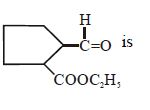
Correct name of
In reaction $A + 2B$ $ \rightleftharpoons $ $2C + D$, initial concentration of $B$ was $1.5\, times$ of $[A]$ , but at equilibrium the concentrations of $A$ and $B$ became equal. The equilibrium constant for the reaction is
Solubility product of a sulphide $MS$  is $3 \times {10^{ - 25}}$ and that of another sulphide $NS $ is $4 \times {10^{ - 40}}$. In ammoniacal solution