MCQ
According to Bronsted-Lowry concept an acid is a substance which
  • A
    accepts proton
  • B
    gives an electron pair
  • gives proton
  • D
    combines with $H_3O^+$ ions

Answer

Correct option: C.
gives proton
c

Need a full question paper?

Generate a complete, print-ready paper with questions like this in minutes — across 16+ boards, with answer keys.

Start Generating Free

Similar questions

According to $CIP$ sequence rule, the correct arrangement in order of decreasing priority is :-
A fuel cell use $CH_4$ gas and it forms $CO_3^{-2}$ at anode. It used to power a car with $96.5\  amp$ for $104\  sec$. The volume of $CH_4$ gas required at $1\  atm$ and $273\  K$ is ............ $\mathrm{L}$
The spin-only magnetic moment value of an octahedral complex among $CoCl _{3} \cdot 4 NH _{3}$, $NiCl _{2} \cdot 6 H _{2} O$ and $PtCl _{4} \cdot 2 HCl$, which upon reaction with excess of $AgNO _{3}$ gives $2\, moles$ of $AgCl$ is $....\,B.M.$ (Nearest Integer)
The $IUPAC$ name of (figure) is
If the electron jumps from $7.00\,eV$ energy level to $5.0\,eV$ energy level, it :
Reaction of phenol with chloroform in presence of dilute sodium hydroxide finally introduces which one of the following functional group ?
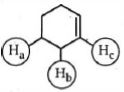
Rank the hydrogen atoms $(H_a , H_b, H_c,)$ in the following molecules according to their acidic strengths
Following limiting molar conductivities are given as

$\lambda_{\mathrm{m}\left(\mathrm{H}_{2} \mathrm{SO}_{4}\right)}^{0}=\mathrm{x} \;\mathrm{S}\; \mathrm{cm}^{2} \mathrm{mol}^{-1}$

$\lambda_{\mathrm{m}\left(\mathrm{K}_{2} \mathrm{SO}_{4}\right)}^{0}=\mathrm{y} \;\mathrm{S\;cm}^{2} \mathrm{mol}^{-1}$

$\lambda_{\mathrm{m}(\mathrm{CH_3} \mathrm{COOK})}^{0}=\mathrm{z}\; \mathrm{S\;cm}^{2} \mathrm{mol}^{-1}$

$\lambda_{\mathrm{m}}^{0}\left(\mathrm{in}\; \mathrm{S} \;\mathrm{cm}^{2} \mathrm{mol}^{-1}\right)$ for $\mathrm{CH}_{3} \mathrm{COOH}$ will be

A very dilute acidic solution of $Cd^{2+}$ and $Ni^{2+}$ gives only yellow ppt. of  $CdS$ on passing $H_2S$, this is due to
Correct decreasing order of boiling point of given compounds
$I.\,HCl$          $II.\,\,H_2O$            $III.\,\,HF$              $IV.\,\,NH_3$