Question
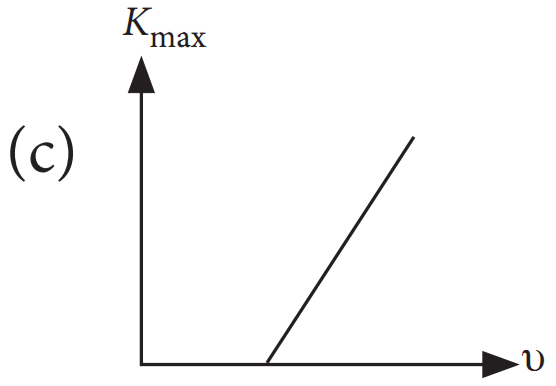
According to Einstein, when a photonoflight offrequencyu or wavelength $\lambda$ is incident on a photosensitive metal surface of work function $\phi_0$, where $\phi_0<\text{h}\upsilon \ ($here $, h$ is Planck's constant$),$ then the emission of photoelectrons takes place. The maximum kinetic energy of the emitted photoelectrons is given by $\text{K}_\text{max}=\text{h}\upsilon-\phi_0$. If the frequency of the incident light is $\upsilon_0$ called thresold frequency, the photoelectrons are emitted from metal without any kinetic energy. So $\text{h}\upsilon_0=\phi_0$.



- A metal of work function $3.3eV$ is illuminated by light of wavelength $300\ nm$. The maximum kinetic energy of photoelectrons emitted is $($taking $h = 6.6 \times 10^{-34} Js).$
- $0.413eV$
- $0.825eV$
- $1.65eV$
- $1.32eV$
- The variation of maximum kinetic energy $(K_{max})$ of the variation of maximum kinetic energy $(\upsilon)$ of the incident radiations can be represented by:
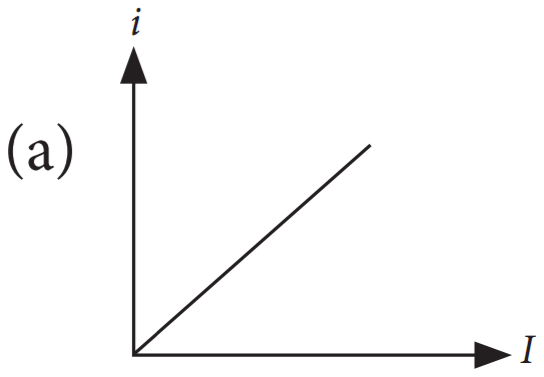
- The variation of photoelectric current $(i)$ with the intensity of the incident radiation $(I)$ can be represented by:
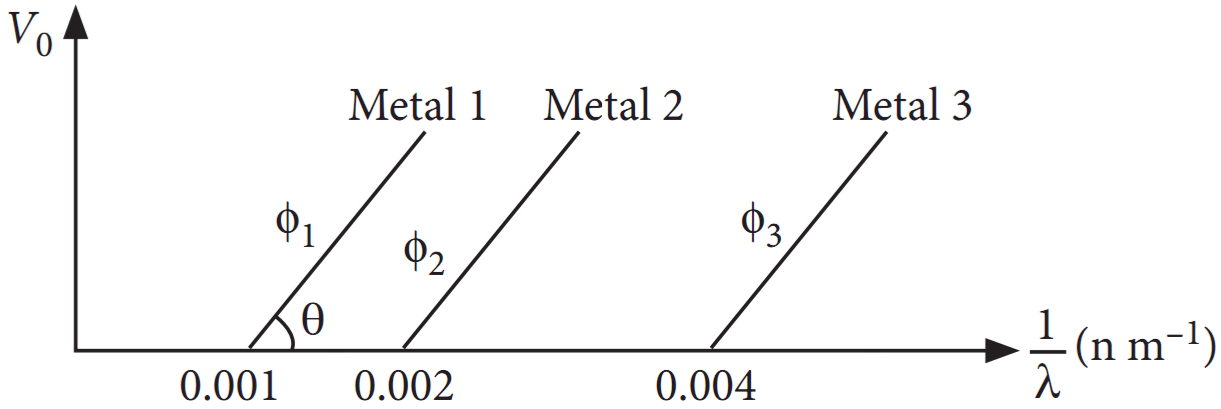
- The graph between the stopping potential $(V_0)$ and $\Big(\frac{1}{\lambda}\Big)$ is shown in the figure. $\phi_1,\phi_2,\phi_3$ are work function. Which of the following options is correct?
- $\phi_1:\phi_2:\phi_3=1:2:3$
- $\phi_1:\phi_2:\phi_3=4:2:1$
- $\phi_1:\phi_2:\phi_3=1:2:4$
- Ultraviolet tight can be used to emit photoelectrons from metal $2$ and metal $3$ only.
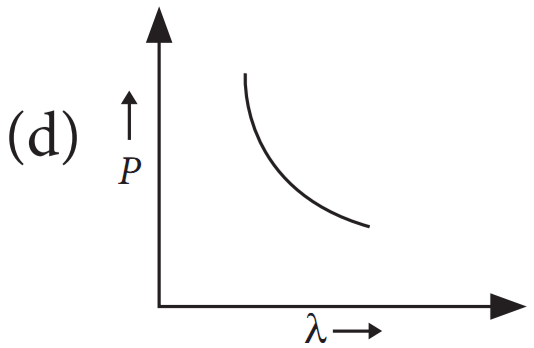
- Which of the following figures represent the variation of particle momentum and the associated de $-$ Broglie wavelength?