Question



✓
Answer
- (b) 0.825eV
Explanation:
$\text{K}_\text{max}=\text{h}\upsilon-\phi_0=\frac{\text{hc}}{\lambda}-\phi_0$
$=\frac{(6.6\times10^{-34})\times(3\times10^8)}{(300\times10^{-9})\times(1.6\times10^{-19})}-3.3$
$=4.125\times3.3=0.825\text{eV} $
Explanation:
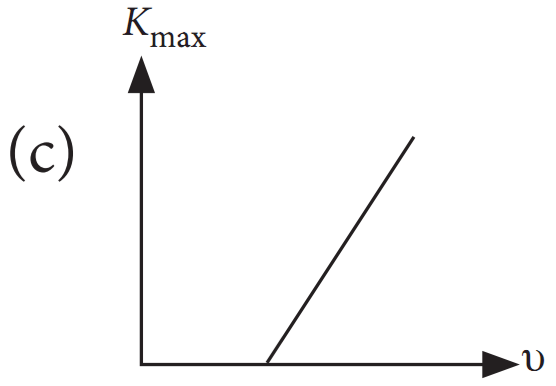
$\text{K}_\text{max}=\text{h}\upsilon-\phi_0$, when $\upsilon=\upsilon_0,\text{K}_\text{max}=0$
$\therefore0=\text{h}\upsilon_0$ or $\phi_0=\text{h}\upsilon_0$
If $\upsilon<\upsilon_0$, then Kmax is negative, i.e., no photoelectric emission takes place. Thus, graph (c) is possible.
Explanation:
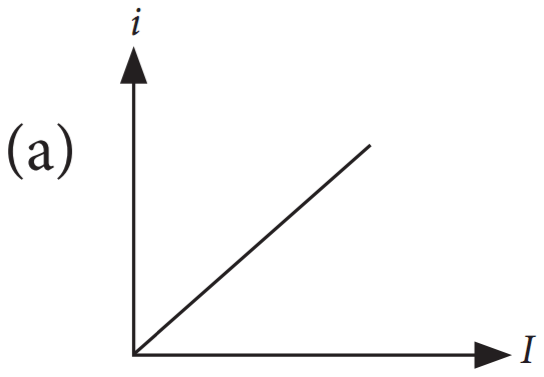
Photoelectric current (i) is proportional to the intensity of the emission light. Thus, graph (a) is possible.
-
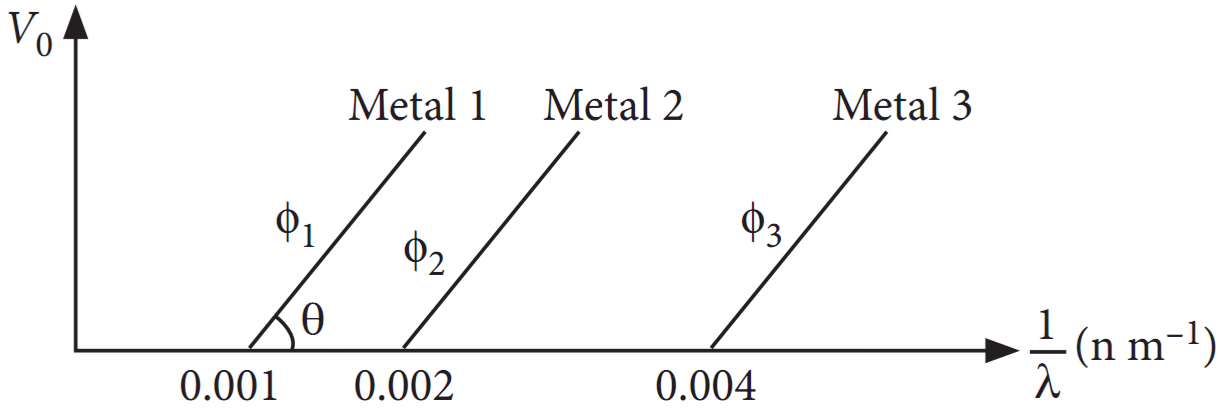
(c) $\phi_1:\phi_2:\phi_3=1:2:4$
Explanation:
From Einstein's photoelectric equation,
$\text{K}_\text{max}=\text{eV}_0=\frac{\text{hc}}{\lambda}-\phi$
or $\text{V}_0=\frac{\text{hc}}{\text{e}}\cdot\frac{1}{\lambda}-\frac{\phi}{\text{e}}$
Graph of V0 versus $\frac{1}{\lambda}$ s a straight line
Slope of straight line, $\tan\theta=\frac{\text{hc}}{\text{e}}$
At V0 = 0, we have
$\phi_1:\phi_2:\phi_3=\frac{\text{hc}}{\lambda_{01}}:\frac{\text{hc}}{\lambda_{02}}:\frac{\text{hc}}{\lambda_{03}}$
$0.001\text{hc}:0.002\text{hc}:0.004\text{hc}$
$\therefore1:2:4$
Explanation:
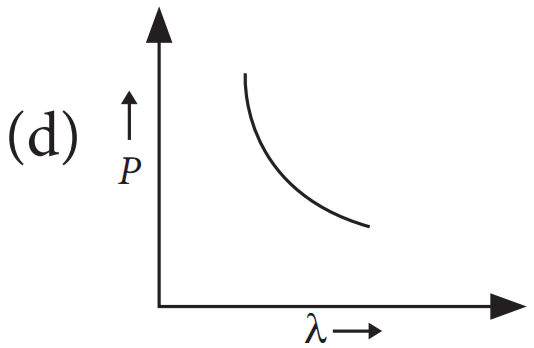
de-Broglie wavelength
$\lambda=\frac{\text{h}}{\text{P}}\text{i.e.,}\lambda\propto\frac{1}{\text{P}}$
So the graph between $\lambda$ and p is of the type shown is option (d).
Need a full question paper?
Generate a complete, print-ready paper with questions like this in minutes — across 16+ boards, with answer keys.
Explore more
Similar questions
A bar magnet makes 40 oscillations per minute in an oscillation magnetometer. An identical magnet is demagnetized completely and is placed over the magnet in the magnetometer. Find the time taken for 40 oscillations by this combination. Neglect any induced magnetism.
When a glass capillary tube is dipped at one end in water, water rises in the tube. The gravitational potential energy is thus increased. Is it a violation of conservation of energy?
At a prayer meeting, the disciples sing JAI-RAM JAI-RAM. The sound amplified by a loudspeaker comes back after reflection from a building at a distance of 80m from the meeting. What maximum time interval can be kept between one JAI-RAM and the next JAI-RAM so that the echo does not disturb a listener sitting in the meeting. Speed of sound in air is 320m/s.
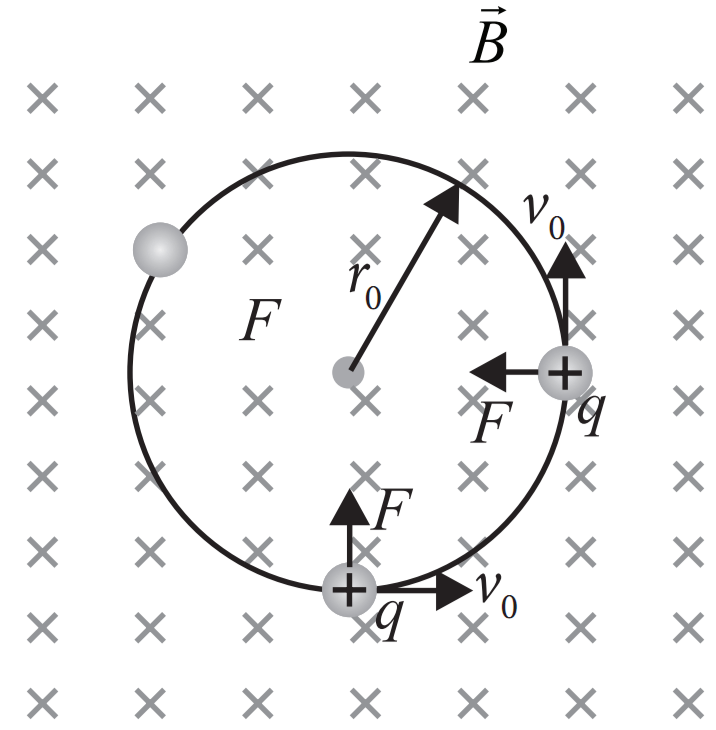
An electron with speed v0 << c moves in a circle of radius r0 in a uniform magnetic field. This electron is able to traverse a circular path as magnetic field is perpendicular to the velocity of the electron. A force acts on the particle perpendicular to both $\vec{\text{v}}_0$ and $\vec{\text{B}},$ This force continuously deflects the particle sideways without changing its speed and the particle will move along a circle perpendicular to the field. The time required for one revolution of the electron is T0.
→
- If the speed of the electron is now doubled to 2v0. The radius of the circle will change to:
- 4r0
- 2r0
- r0
- $\frac{\text{r}_0}{2}$
- If v0 = 2v0 then the time required for one revolution of the electron will change to:
- 4T0
- 2T0
- T0
- $\frac{\text{T}_0}{2}$
- A charged particles is projected in a magnetic field $\vec{\text{B}}=(2\hat{\text{i}}+4\hat{\text{j}})\times10^2\text{ T}.$ The acceleration of the particle is found to be $\vec{\text{a}}=(\text{x}\hat{\text{i}}+2\hat{\text{j}})\text{m s}^{-2}$ Find the value of x.
- 4ms-2
- -4ms-2
- -2ms-2
- 2ms-2
- If the given electron has a velocity not perpendicular to B, then trajectory of the electron is:
- Straight line.
- Circular.
- Helical.
- Zig-zag.
- If this electron of charge (e) is moving parallel to uniform magnetic field with constant velocity v, the force acting on the electron is:
- Bev
- $\frac{\text{Be}}{\text{v}}$
- $\frac{\text{B}}{\text{ev}}$
- Zero
A magnetic dipole of magnetic moment 1.44A-m2 is placed horizontally with the north pole pointing towards north. Find the position of the neutral point if the horizontal component of the earth's magnetic field is $18 \mu\text{T}.$
→Derive $\delta=i+e- A$ for a Prism. Also derive an expression for the refractive index of material of the Prism.
→(a) What will be the charge on $12.5 \times 10^8$ electrons?(b) Which is larger between 1 Coulomb charge and 1 electron charge? How many electronic charges will there be in one Coulomb charge?
→A small object is embedded in a glass sphere $(\mu=1.5)$ of radius 5.0cm at a distance 1.5cm left to the centre. Locate the image of the object as seen by an observer standing.
→- To the left of the sphere.
- To the right of the sphere.
By mistake, an eye surgeon puts a concave lens in place of the lens in the eye after a cataract operation. Will the patient be able to see clearly any object placed at any distance?
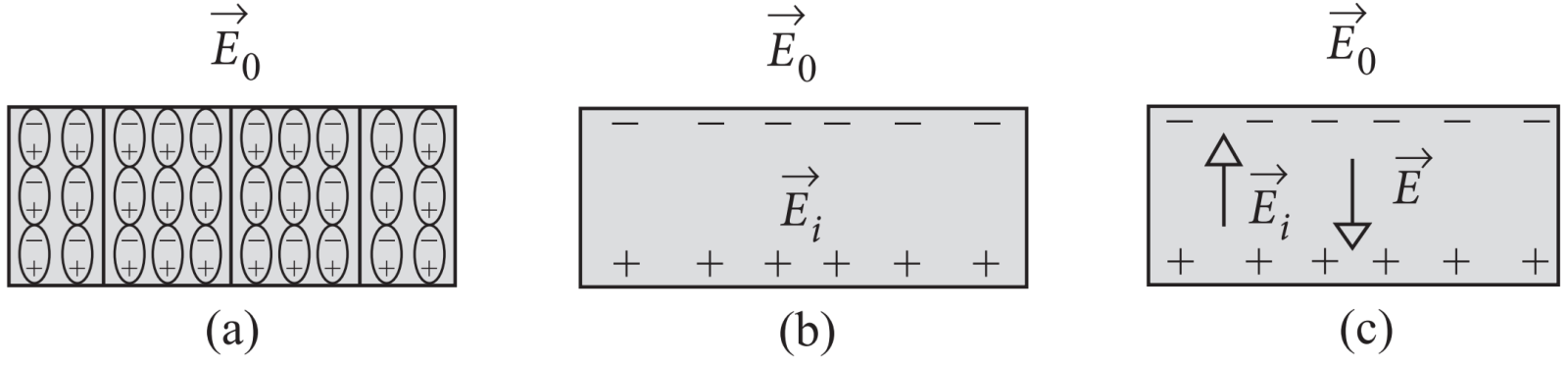
When an insulator is placed in an external field, the dipoles become aligned. Induced surface charges on the insulator establish a polarization field $\vec{\text{E}}_\text{i}$ in its interior. The net field $\vec{\text{E}}$ in the insulator is the vector sum of $\vec{\text{E}}_0$ and $\vec{\text{E}}_\text{i}$ as shown in the figure.
→
- Which among the following is an example of polar molecule?
- O2
- H2
- N2
- HCI
- When air is replaced by a dielectric medium of constant K, the maximum force of attraction between two charges separated by a distance:
- Increases K times.
- Remains unchanged.
- Decreases K times.
- Increases 2K times.
- Which of the following is a dielectric?
- Copper.
- Glass.
- Antimony (Sb).
- None of these.
- For a polar molecule, which of the following statements is true?
- The centre of gravity of electrons and protons coincide.
- The centre of gravity of electrons and protons do not coincide.
- The charge distribution is always symmetrical.
- The dipole moment is always zero.
- When a comb rubbed with dry hair attracts pieces of paper. This is because the?
- Comb polarizes the piece of paper.
- Comb induces a net dipole moment opposite to the direction of field.
- Electric field due to the comb is uniform.
- Comb induces a net dipole moment perpendicular to the direction of field.