Question



✓
Answer
- (b) 0.825eV
Explanation:
$\text{K}_\text{max}=\text{h}\upsilon-\phi_0=\frac{\text{hc}}{\lambda}-\phi_0$
$=\frac{(6.6\times10^{-34})\times(3\times10^8)}{(300\times10^{-9})\times(1.6\times10^{-19})}-3.3$
$=4.125\times3.3=0.825\text{eV} $
Explanation:
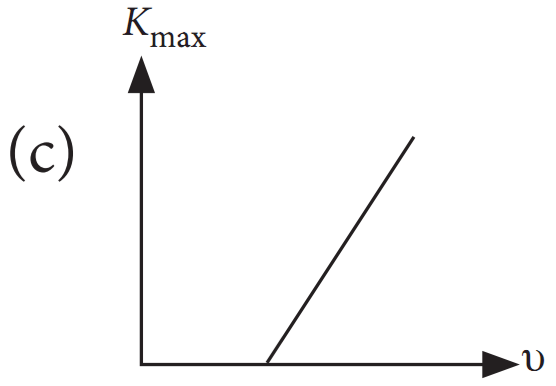
$\text{K}_\text{max}=\text{h}\upsilon-\phi_0$, when $\upsilon=\upsilon_0,\text{K}_\text{max}=0$
$\therefore0=\text{h}\upsilon_0$ or $\phi_0=\text{h}\upsilon_0$
If $\upsilon<\upsilon_0$, then Kmax is negative, i.e., no photoelectric emission takes place. Thus, graph (c) is possible.
Explanation:
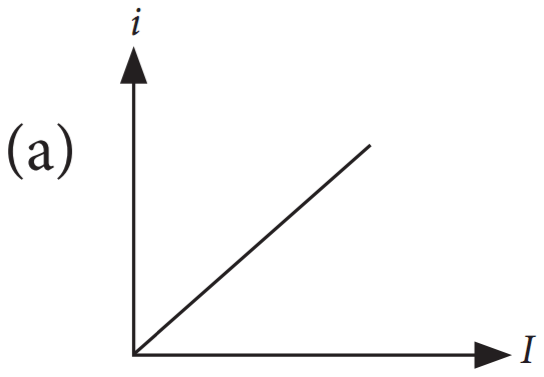
Photoelectric current (i) is proportional to the intensity of the emission light. Thus, graph (a) is possible.
-
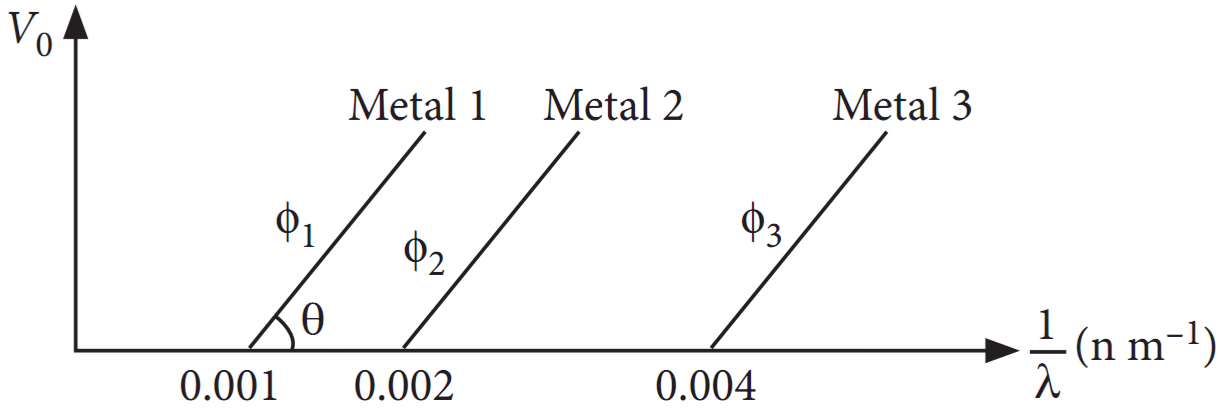
(c) $\phi_1:\phi_2:\phi_3=1:2:4$
Explanation:
From Einstein's photoelectric equation,
$\text{K}_\text{max}=\text{eV}_0=\frac{\text{hc}}{\lambda}-\phi$
or $\text{V}_0=\frac{\text{hc}}{\text{e}}\cdot\frac{1}{\lambda}-\frac{\phi}{\text{e}}$
Graph of V0 versus $\frac{1}{\lambda}$ s a straight line
Slope of straight line, $\tan\theta=\frac{\text{hc}}{\text{e}}$
At V0 = 0, we have
$\phi_1:\phi_2:\phi_3=\frac{\text{hc}}{\lambda_{01}}:\frac{\text{hc}}{\lambda_{02}}:\frac{\text{hc}}{\lambda_{03}}$
$0.001\text{hc}:0.002\text{hc}:0.004\text{hc}$
$\therefore1:2:4$
Explanation:
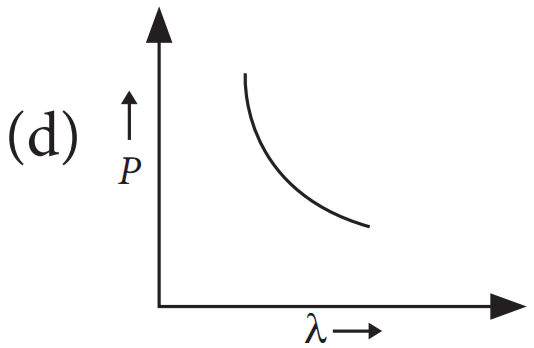
de-Broglie wavelength
$\lambda=\frac{\text{h}}{\text{P}}\text{i.e.,}\lambda\propto\frac{1}{\text{P}}$
So the graph between $\lambda$ and p is of the type shown is option (d).
Need a full question paper?
Generate a complete, print-ready paper with questions like this in minutes — across 16+ boards, with answer keys.
Explore more
Similar questions
A solenoid 60 cm long and of radius 4.0 cm has 3 layers of windings of 300 turns each. A 2.0 cm long wire of mass 2.5 g lies inside the solenoid (near its centre) normal to its axis; both the wire and the axis of the solenoid are in the horizontal plane. The wire is connected through two leads parallel to the axis of the solenoid to an external battery which supplies a current of 6.0 A in the wire. What value of current (with appropriate sense of circulation) in the windings of the solenoid can support the weight of the wire? g = 9.8 m s–2.
The electrostatic force on a small sphere of charge $0.4 \mu C$ due to another small sphere of charge $-0.8 \mu C$ in air is 0.2 N (a) What is the distance between the two spheres? (b) What is the force on the second sphere due to the first?
→The number of free electrons in a unit volume copper conductor estimated in Example 8.1 is 8.5 x 1028 per m3.How long does an electron take to drift from one end of a wire 3.0 m long to its other end? The area of cross-section of the wire is 2.0 x 10⁻⁶ m2and it is carrying a current of 3.0 A.
Find the acceleration due to gravity of the moon at a point 1000km above the moon's surface. The mass of the moon is 7.4 × 10²²kg and its radius is 1740km.
Suppose the bent part of the frame of the previous problem has a thermal conductivity of 780Js-1m-1°C-1 whereas it is 390Js-1m-1°C-1 for the straight part. Calculate the ratio of the rate of heat flow through the bent part to the rate of heat flow through the straight part.
A collision experiment is done on a horizontal table kept in an elevator. Do you expect a change in the results if the elevator is accelerated up or down because of the noninertial character of the frame?
What do you mean by coherent sources of light? How are these obtained in the laboratory ?
There are materials which absorb photons of shorter wavelength and emit photons of longer wavelength. Can there be stable substances which absorb photons of larger wavelength and emit light of shorter wavelength.