MCQ
According to Kepler, planets move in
  • A
    Circular orbits around the sun
  • B
    Elliptical orbits around the sun with sun at exact centre
  • C
    Straight lines with constant velocity
  • Elliptical orbits around the sun with sun at one of its foci

Answer

Correct option: D.
Elliptical orbits around the sun with sun at one of its foci
d
(d)

Kepler's first law,

Law of Orbits : All planets move in elliptical orbits, with the surn at one of the foci of the ellipse.

Need a full question paper?

Generate a complete, print-ready paper with questions like this in minutes — across 16+ boards, with answer keys.

Start Generating Free

Similar questions

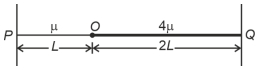
Two uniform strings of mass per unit length $\mu$ and $4 \mu$, and length $L$ and $2 L$, respectively, are joined at point $O$, and tied at two fixed ends $P$ and $Q$, as shown in the figure. The strings are under a uniform tension $T$. If we define the frequency $v_0=\frac{1}{2 L} \sqrt{\frac{T}{\mu}}$, which of the following statement($s$) is(are) correct?

$(A)$ With a node at $O$, the minimum frequency of vibration of the composite string is $v_0$

$(B)$ With an antinode at $O$, the minimum frequency of vibration of the composite string is $2 v_0$

$(C)$ When the composite string vibrates at the minimum frequency with a node at $O$, it has $6$ nodes, including the end nodes

$(D)$ No vibrational mode with an antinode at $O$ is possible for the composite string
Under which of the following conditions is the law $PV = RT$ obeyed most closely by a real gas
Gravitational acceleration on the surface of a planet is $\frac{\sqrt 6}{11}g$ , where $g$ is the gravitational acceleration on the surface of the earth. The average mass  density of the planet is $\frac{2}{3}\, times$ that of the earth. If the escape speed on the surface of the earth is taken to be $11\, kms^{-1}$, the escape speed on the surface of  the  planet in $kms^{-1}$ will be
A gas mixture consists of $3$ moles of oxygen and $5$ moles of argon at temperature $T$. Assuming the gases to be ideal and the oxygen bond to be rigid, the total internal energy (in units of $RT$ ) of the mixture is
A $1 \,kg$ stone at the end of $1 \,m$ long string is whirled in a vertical circle at constant speed of $4\, m/sec$. The tension in the string is $6 \,N$, when the stone is at
A sample of $1$ mole gas at temperature $\mathrm{T}$ is adiabatically expanded to double its volume. If adiabatic constant for the gas is $\gamma=\frac{3}{2}$, then the work done by the gas in the process is:
Three observers A, B and C measure the speed of light coming from a source to be vA, 0B and vc. The observer A moves towards the source and C moves away from the source at the same speed. The observer B stays stationary. The surrounding space is vacuum everywhere.

  1. $\text{v}_\text{A}>\text{v}_\text{B}>\text{v}_\text{C}.$

  2. $\text{v}_\text{A}<\text{v}_\text{B}<\text{v}_\text{C}$

  3. $\text{v}_\text{A}=\text{v}_\text{B}=\text{v}_\text{C}$

  4. $\text{v}_\text{B}=\frac{1}{2}(\text{v}_\text{A}+\text{v}_\text{C})$

A uniform rod of density $\rho $ is placed in a wide tank containing a liquid of density ${\rho _0}({\rho _0} > \rho )$. The depth of liquid in the tank is half the length of the rod. The rod is in equilibrium, with its lower end resting on the bottom of the tank. In this position the rod makes an angle $\theta $ with the horizontal
A source of sound gives five beats per second when sounded with another source of frequency $100\,{s^{ - 1}}$. The second harmonic of the source together with a source of frequency $205\,{s^{ - 1}}$ gives five beats per second. What is the frequency of the source .... ${s^{ - 1}}$
The ends of a stretched wire of length $L$ are fixed at $x = 0$ and $x = L.$ In one experiment, the displacement of the wire is ${y_1} = A\sin (\pi x/L)\sin \omega t$ and energy is ${E_1}$, and in another experiment its displacement is ${y_2} = A\sin (2\pi x/L)\sin 2\omega t$ and energy is ${E_2}$. Then