MCQ
According to Lenz's law there is conversion of:
  • A
    Momentum.
  • B
    Collision.
  • C
    Voltage.
  • Energy.

Answer

Correct option: D.
Energy.

Lenz's law deals with conversion of mechanical energy into electromagnetic energy in case of electromagnetic induction. Hence Lenz's law is basically a conversion of energy from one form to another.

Need a full question paper?

Generate a complete, print-ready paper with questions like this in minutes — across 16+ boards, with answer keys.
Start Generating Free

Similar questions

When the $N-$pole of a bar magnet points towards the south and $S-$pole towards the north, the null points are at the
The distance between ${H^ + }$ and $C{l^ - }$ ions in $HCl$ molecule is $1.28\,\mathop A\limits^o $. What will be the potential due to this dipole at a distance of $12\,\mathop A\limits^o $ on the axis of dipole......$V$
A coil has an inductance of $2 H$ and resistance of $4\,\Omega$. A $10\,V$ is applied across the coil. The energy stored in the magnetic field after the current has built up to its equilibrium value will be $..........\times 10^{-2} J$
What is the dielectric constant of a metal?
A steady current $I$ goes through a wire loop $\mathrm{PQR}$ having shape of a right angle triangle with $\mathrm{PQ}=3 x, \mathrm{PR}=4 x$ and $\mathrm{QR}=5 x$. If the magnitude of the magnetic field at $\mathrm{P}$ due to this loop is $k\left(\frac{\mu_0 I}{48 \pi x}\right)$, find the value of $k$.
An object is placed $20\, cm$ in front of a $4\, cm$ thick plane mirror. The image of the object finally is formed at $45\, cm $ from the object itself . The refractive index of the material of the unpolished side of the mirror is (considering near normal incidence)
Assertion : The presence of water molecules makes separation of ions easier in electrolyte.
Reason : The presence of water molecules in electrolyte decreases the resistance of electrolyte.
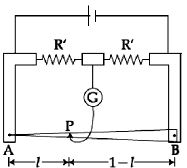
In a meter bridge, the wire of length $1\, m$ has a nonuniform cross-section such that, the variation $\frac{{dR}}{{d\ell }}$ of its resistance $R$ with length $\ell $ is $\frac{{dR}}{{d\ell }} \propto \frac{1}{{\sqrt \ell  }}$ Two equal resistances are connected as shown in the figure. The galvanometer has zero deflection when the jockey is at point $P$. What is the length $AP$ ? ................ $m$
A printed page is pressed by a glass of water. The refractive index of the glass and water is $1.5$ and $1.33$, respectively. If the thickness of the bottom of glass is $1\, cm$ and depth of water is $5\, cm$ , how much the page will appear to be shifted if viewed from the top ?
Two parallel pillars are 11 km away from an observer. The minimum distance between the pillars so that they can be seen separately will be