MCQ
According to Maxwell’s Hypothesis, a changing electric field gives rise to?
  • A
    Induced $\text{EMF}$
  • B
    Electric Field
  • Magnetic Field
  • D
    Magnetic Dipole

Answer

Correct option: C.
Magnetic Field
A changing electric field gives rise to a magnetic field.

Need a full question paper?

Generate a complete, print-ready paper with questions like this in minutes — across 16+ boards, with answer keys.
Start Generating Free

Similar questions

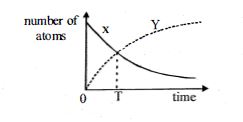
The graph represents the decay of a newly prepared sample of radioactive nuclide $X$ to a stable nuclide $Y$ . The half-life of $X$ is $\tau $ .  The growth curve for $Y$ intersects the decay curve for $X$ after time $T$ . What is the time $T$ ?
Assertion : Soft and hard $X-$ rays differ in frequency as well as velocity.
Reason : The penetrating power of hard $X-$ rays is more than the penetrating power of soft $X-$ rays.
The number of photons per second on an average emitted by the source of monochromatic light of wavelength $600\, \mathrm{~nm}$, when it delivers the power of $3.3 \times 10^{-3}$ $watt$ will be : $\left(\mathrm{h}=6.6 \times 10^{-34}\, \mathrm{Js}\right)$
A plane electromagnetic wave is incident on a material surface. The wave delivers momentum $p$ and energy $E.$
Which of the following phenomena can explain quantum nature of light
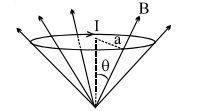
A circular current loop of radius a is placed in a radial field $B$ as shown. The net force acting on the loop is
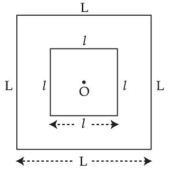
A small square loop of wire of side $l$ is placed inside a large square loop of wire $L(L \gg l)$. Both loops are coplanar and their centres coincide at point $O$ as shown in figure. The mutual inductance of the system is.
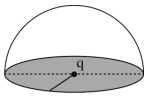
If a charge $q$ is placed at the centre of a closed hemispherical non-conducting surface, the total flux passing through the flat surface would be
An $\alpha -$ particle moves in a circular path of radius $0.83\,\, cm$ in the presence of a magnetic field of $0. 25\,\, Wb/m^2$. The de Broglie wavelength associated with the particle will be .............. $\mathring A$
A thin spherical conducting shell of radius R has a charge q. Another charge Q is placed at the centre of the shell. The electrostatic potential at a point p a distance $\frac{R}{2}$ from the centre of the shell is