Question
According to Maxwell's theory of electrodynamics, an electron going in a circle should emit radiation of frequency equal to its frequency of revolution. What should be the wavelength of the radiation emitted by a hydrogen atom in ground state if this rule is followed?
Answer

Frequency of the revolution in the ground state is $\frac{\text{V}_0}{2\pi\text{r}_0}$ [$r_0$ = radius of ground state, $V_0​​​​​​​$ = velocity in the ground state]$\therefore$ Frequency of radiation emitted is $\frac{\text{V}_0}{2\pi\text{r}_0}=\text{f}$
$\therefore\text{C}=\text{f}\lambda$
$\lambda=\frac{\text{C}}{\text{f}}=\frac{2\pi\text{C}\text{r}_0}{\text{V}_0}$
$\therefore\lambda=\frac{2\pi\text{C}\text{r}_0}{\text{V}_0}$
$\lambda=45.686\text{nm}=45.7\text{nm}$

Need a full question paper?

Generate a complete, print-ready paper with questions like this in minutes — across 16+ boards, with answer keys.

Start Generating Free

Similar questions

When pressure increases by 1%, what is the percentage decrease in the volume of a gas, if Boyle's law is obeyed?
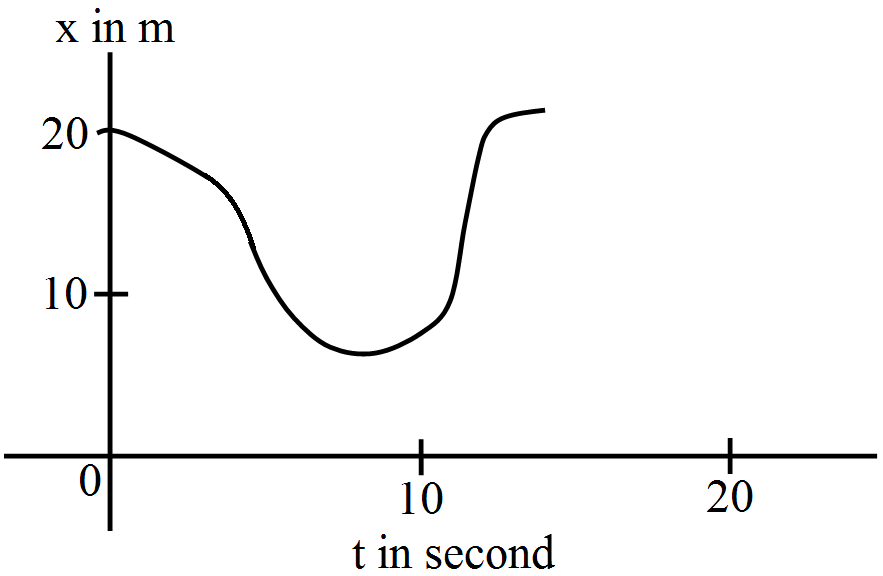
Figure shows x-t graph of a particle. Find the time t such that the average velocity of the particle during the period 0 to t is zero.
A monkey is sitting on a tree limb. The limb exerts a normal force of 48N and a frictional force of 20N. Find the magnitude of the total force exerted by the limb on the monkey.
A man walks on a straight road from his home to a market 2.5 km away with a speed of $5 \mathrm{~km}{ }^{\mathrm{h}-1}$. Finding the market closed, he instantly turns and walks back home with a speed of $7.5 \mathrm{~km} \mathrm{~h}^{-1}$. What is the Magnitude of average velocity, and.
A transverse harmonic wave on a string is described by
$\text{y}(\text{x, t})=3.0\sin\big(36\text{t}+0.018\text{x}+\frac{\pi}{4}\big)$
where x and y are in cm and t in s. The positive direction of x is from left to right.
What are its amplitude and frequency?
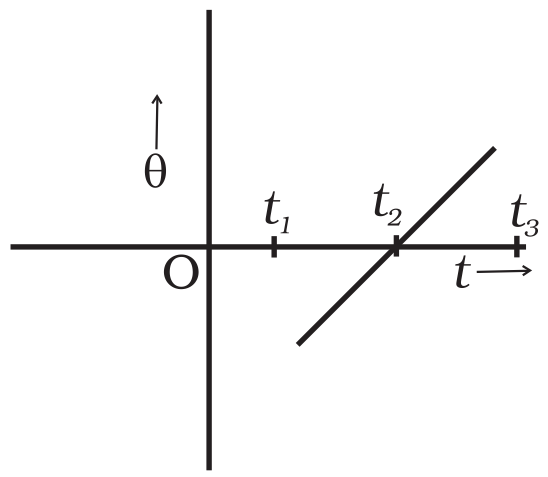
The variation of angular position of a point on a rotating rigid body, with time t is shown in is the body rotating clock-wise or anti-clockwise?
A body has a sense of weightlessness in a satellite revolving around the earth, why?
Two particles begin to fall freely from rest from the top of a tower within a gap of 1 s. How long after the first particle begins to fall, the two particles be 15m apart? (Given $\mathrm{g}=10 \mathrm{~ms}^{-2}$ )
If $\text{A}=(12.0\pm0.1)\text{cm}$ and $\text{B}=(8.5\pm0.5)\text{cm},$ find:
  1. $\text{A}+\text{B}$
  2. $\text{A}-\text{B}$
A particle is moving in a straight line. Is it possible for it to maintain the motion in the same direction while the acceleration is in the reverse direction?