MCQ
According to Reynolds, what will be the value of critical velocity?
  • $\frac{R \eta}{\rho D }$
  • B
    $\frac{ RD }{\rho \eta}$
  • C
    $\frac{\rho D }{ R \eta}$
  • D
    $\frac{\rho D v C }{\eta}$

Answer

Correct option: A.
$\frac{R \eta}{\rho D }$
A

Need a full question paper?

Generate a complete, print-ready paper with questions like this in minutes — across 16+ boards, with answer keys.
Start Generating Free

Similar questions

Assume that the acceleration due to gravity on the surface of the moon is $0.2$ times the acceleration due to gravity on the surface of the earth. If ${R_e}$ is the maximum range of a projectile on the earth’s surface, what is the maximum range on the surface of the moon for the same velocity of projection
A particle is moving on a circular path of radius $r$ with uniform speed $v$. What is the displacement of the particle after it has described an angle of $60^o$ ?
If the temperature of a hot body is increased by $50\%$  then the increase in the quantity of emitted heat radiation will be ..... $\%$
The pressure of an ideal gas is written as $\text{p}=\frac{2\text{E}}{3\text{v}}.$ Here $E$ refers to:
A girl standing on road holds her umbrella at $45^{\circ}$ with the vertical to keep the rain away. If she starts running without umbrella with a speed of $15 \sqrt{2} \; kmh ^{-1}$, the rain drops hit her head vertically. The speed of rain drops with respect to the moving girl is ...........  $kmh ^{-1}$
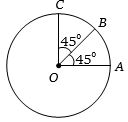
Find the resultant of three vectors $\overrightarrow {OA} ,\,\overrightarrow {OB} $ and $\overrightarrow {OC} $ shown in the following figure. Radius of the circle is $R$.
The hour hand of a clock is $6\,cm$ long. The magnitude of the displacement of the tip of hour between $1:00\,PM$ to $5:00\,PM$ is
Assume that the earth is a solid sphere of uniform density and a tunnel is dug along its diameter throughout the earth. It is found that when a particle is released in this tunnel, it executes a simple harmonic motion. The mass of the particle is $100 g$. The time period of the motion of the particle will be (approximately) (take $g =10\,ms ^{-2}$, radius of earth $=6400\,km$ )
A weightless spring which has a force constant oscillates with frequency $n$ when a mass $m$ is suspended from it. The spring is cut into two equal halves and a mass $2m $ is suspended from it. The frequency of oscillation will now become
A cubic vessel $($with face horizontal $+$ vertical$)$ contains an ideal gas at $\text{NTP.}$ The vessel is being carried by a rocket which is moving at a speed of $500\ ms^{-1}$ in vertical direction. The pressure of the gas inside the vessel as observed by us on the ground: