MCQ
According to the Heisenberg uncertainty principle:
  • A
    Momentum of an electron can be found exactly if its position is known.
  • B
    The lowest energy of an atom can hold only one electron.
  • C
    Light has a dual nature- wave and photon.
  • There is a limit to the accuracy of the measurement of subatomic particles.
Answer

Correct option: D.
There is a limit to the accuracy of the measurement of subatomic particles.
Explanation: d. There is a limit to the accuracy of the measurement of subatomic particles.
According to the Heisenberg uncertainty principle, the position and the momentum of the particle cannot be measured accurately simultaneously. Thus there is a limitation to the accuracy of the measurement of subatomic particles.

Need a full question paper?

Generate a complete, print-ready paper with questions like this in minutes — across 16+ boards, with answer keys.

Start Generating Free

Similar questions

Ten capacitor are joined in parallel and charged with a battery up to a potential $V$. They are then disconnected from battery and joined again in series then the potential of this combination will be.......$V$
$\lambda_{max}$ is  $6563\  \mathring A$, then wave length of second line for Balmer series will be
When electron remains between orbits, its momentum is:
The ratio of minimum to maximum wavelength in Balmer series is
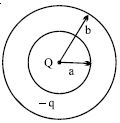
 Aspherical shell with an inner radius $'a'$ and an outer radius $'b' $ is made of conducting material. A point charge $+Q$ is placed at the centre of the spherical shell and a total charge $- q $ is placed on the shell.

Charge $- q $ is distributed on the surfaces as

The current flowing in two coaxial coils in the same direction. On increasing the distance between the two, the electric current will
A photocell stops emission if it is maintained at 2V negative potential. The energy of most energetic photoelectron is
A light ray is incident on the surface of a sphere of refractive index $n$ at an angle of incidence $\theta_0$. The ray partially refracts into the sphere with angle of refraction $\phi_0$ and then partly reflects from the back surface. The reflected ray then emerges out of the sphere after a partial refraction. The total angle of deviation of the emergent ray with respect to the incident ray is $\alpha$. Match the quantities mentioned in $List-I$ with their values in $List-II$ and choose the correct option.
$List-I$ $List-II$
($P$) If $n=2$ and $\alpha=180^{\circ}$, then all the possible values of $\theta_0$ will be ($1$) $30^{\circ}$ and $0^{\circ}$
($Q$) If $n=\sqrt{3}$ and $\alpha=180^{\circ}$, then all the possible values of $\theta_0$ will be ($2$) $60^{\circ}$ and $0^{\circ}$
($R$) If $n=\sqrt{3}$ and $\alpha=180^{\circ}$, then all the possible values of $\phi_0$ will be ($3$) $45^{\circ}$ and $0^{\circ}$
($S$) If $n=\sqrt{2}$ and $\theta_0=45^{\circ}$, then all the possible values of $\alpha$ will be ($4$) $150^{\circ}$
  ($5$) $0^{\circ}$
According to photon theory of light which of the following physical quantities associated with a photon do not/does not change as it collides with an electron in vacuum
When a current of $2\, A$ flows in a battery from negative to positive terminal, the potential difference across it is $12\, V$. If a current of $3\, A$ flowing in the opposite direction produces a potential difference of $15\, V$, the $emf$ of the battery is .............. $V$