Question
According to the molecular kinetic theory of gases, what is the mean free path?

Answer

Mean free path : The distance that gas molecules travel before colliding with another molecule is called mean free path. The value of free path may be different in different collisions. We can understand in another way like this.
The avarage distance travelled by a molecule between two consecutive collisions is called mean free path. Let us represent this $\bar{\lambda}$
Mean free path $=\frac{\text { Total distance travelled }}{\text { Number of collisions }}$
If any molecule travel the distance $\lambda_1, \lambda_2, \lambda_3, \ldots \ldots \ldots \lambda_{ N }$ after $\text {t}$ time with $\text {N}$ different collisions then mean free path value will be
$\bar{\lambda}=\frac{\lambda_1+\lambda_2+\lambda_3 \ldots \ldots \ldots \lambda_{ N }}{ N }$
Average free path is inversely proportional to the density of the gas and proportional to the mass of the molecule
$\bar{\lambda} \propto \frac{1}{\rho}$
Free path depend on temperature and pressure that means
$\begin{array}{l}\quad \quad\quad\bar{\lambda} \propto T \\\text {and}\quad \bar{\lambda} \propto \frac{1}{\rho}\end{array}$

Need a full question paper?

Generate a complete, print-ready paper with questions like this in minutes — across 16+ boards, with answer keys.
Start Generating Free

Similar questions

Two identical point masses, each of mass $M$ are connected to one another by a massless string of length $L$. $A$ constant force $F$ is applied at the mid-point of the string. If l be the instantaneous distance between the two masses, what will be the acceleration of each mass?
When the base current in a transistor is changed from $30\mu\text{A}$ to $80\mu\text{A},$ the collector current is changed from 1.0mA to 3.5mA. Find the current gain $\beta.$
Slowing down of neutrons: In a nuclear reactor a neutron of high speed (typically $10^7 m s ^{-1}$ ) must be slowed to $10^3 m s ^{-1}$ so that it can have a high probability of interacting with isotope ${ }_{92}^{235} U$ and causing it to fission. Show that a neutron can lose most of its kinetic energy in an elastic collision with a light nuclei like deuterium or carbon which has a mass of only a few times the neutron mass. The material making up the light nuclei, usually heavy water $\left( D _2 O \right)$ or graphite, is called a moderator.
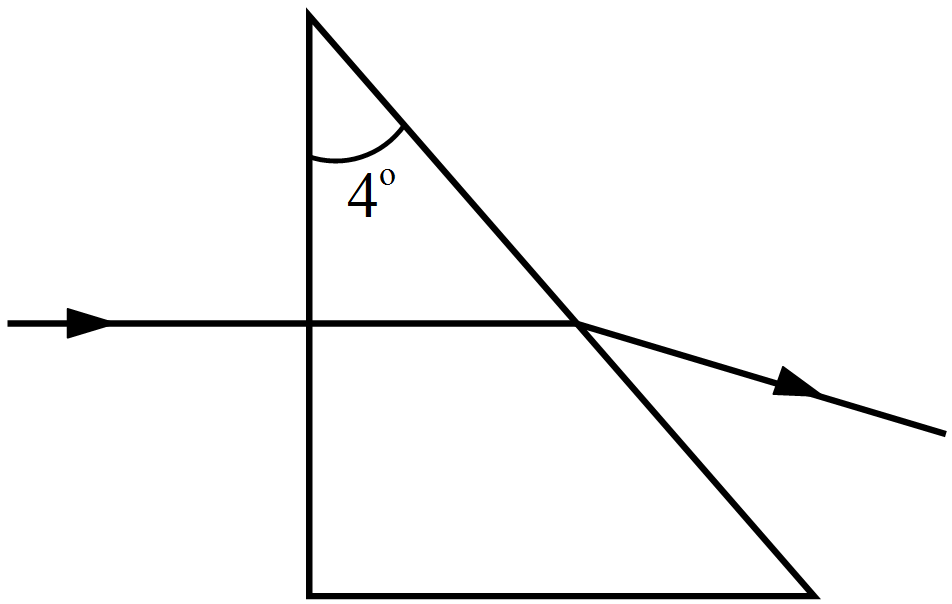
Find the angle of deviation suffered by the light ray shown in figure. The refractive index $\mu=1.5$ for the prism material.
A harmonic oscillation is represented by $\text{y}=0.34\cos(3000\text{t}+0.74),$ where $y$ and $t$ are in $m$ and $s$ respectively. Deduce: $(i)$ the amplitude, $(ii)$ the frequency and angular frequency, $(iii)$ the period, and $(iv)$ the initial phase.
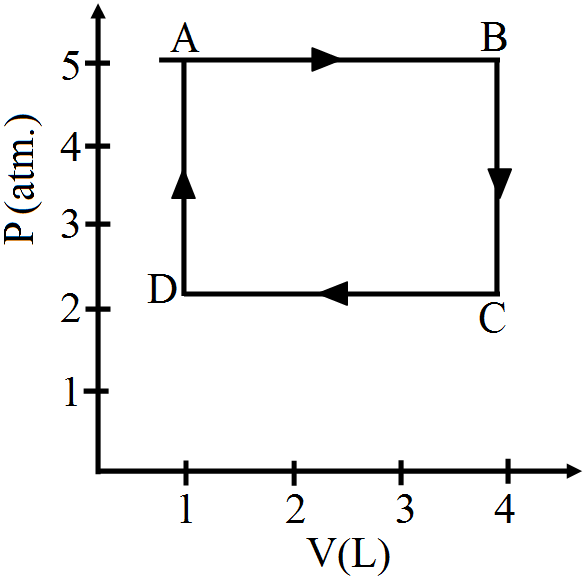
One mole of an ideal gas undergoes a cyclic change ABCD. From the given diagram, calculate the net work done in the process. $1$ atmosphere = $10^\circ dyne\ cm^{-2}$.
A cart of mass M is at rest on a frictionless horizontal surface and a pendulum bob of mass m hangs from the roof of the cart. The string breaks, the bob falls on the floor, makes several collisions on the floor and finally lands up in a small slot made in the floor. The horizontal distance between the string and the slot is L. Find the displacement of the cart during this process.
A particle of 10kg mass is moving in a circle of 4m radius with a constant speed of 5 m/ sec. What is its angular momentum about (i) the centre of circle (ii) a point on the axis of the circle and 3m distant from its centre?
If a number of little droplets of water, each of radius $r$, coalesce to form a single drop of radius $R$, show that the rise in temperature will be given by $\Delta \theta=\frac{3 \sigma}{J}\left(\frac{1}{r}-\frac{1}{R}\right)$ where $\sigma$ is the surface tension of water and J is the mechanical equivalent of heat.
A uniformly moving train passes by a long platform. Consider the events' engine crossing the beginning of the platform' and 'engine crossing the end of the platform'. Which frame (train frame or the platform frame) is the proper frame for the pair of events?