MCQ
According to the Rutherford’s atomic model, the electrons inside the atom are
  • A
    Stationary
  • Not stationary
  • C
    Centralized
  • D
    None of these

Answer

Correct option: B.
Not stationary
b
According to Rutherford's model, an atom is mostly an empty space, with electrons orbiting a fixed positively charged nucleus in set of predictable paths.

Need a full question paper?

Generate a complete, print-ready paper with questions like this in minutes — across 16+ boards, with answer keys.
Start Generating Free

Similar questions

In a potentiometer wire experiment the $\mathrm{emf}$ of a battery in the primary circuit is $20\,V$ and its internal resistance is $5\,\Omega$ . There is a resistance box in series with the battery and the potentiometer wire, whose resistance can be varied from $120\,\Omega$ to $170\,\Omega$ . Resistance of the potentiometer wire is $75\,\Omega$ . The following potential differences can be measured using this potentiometer.
A short linear object of length $l$ lies along the axis of a concave mirror of focal length $f$ at a distance $u$ from the pole of the mirror. The size of the image is approximately equal to
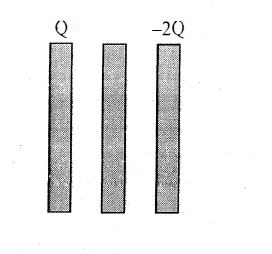
The identical metal plates with large surface areas are kept parallel to each other as shown in figure. The left most plate is given a charge $Q$ , the rightmost a charge $-2Q$ and the middle one remains neutral. Find the charge appearing on the outer surface of the rightmost plate
Arrange the compounds in order of decreasing reactivity for nucleophilic additon reaction

$\mathop {\begin{array}{*{20}{c}}
  {O\,\,\,\,\,\,\,\,\,\,\,\,\,} \\ 
  {||\,\,\,\,\,\,\,\,\,\,\,\,} \\ 
  {C{H_3} - C - C{H_2} - Cl} 
\end{array}}\limits_{\left( I \right)} $    $\underset{(II)}{\mathop{\begin{matrix}
   \,\,\,\,\,\,\,\,\,\,\,\,\,\,\,\,\,\,O  \\
   \,\,\,\,\,\,\,\,\,\,\,\,\,\,\,\,\,\,\,\,\,||\,\,\,  \\
   Cl-C{{H}_{2}}-C-H  \\
\end{matrix}}}\,$

$\mathop {\begin{array}{*{20}{c}}
  O \\ 
  {||} \\ 
  {H - C - H} 
\end{array}}\limits_{\left( {III} \right)} $    $\mathop {\begin{array}{*{20}{c}}
  O \\ 
  {||} \\ 
  {{H_3}C - C - C{H_3}} 
\end{array}}\limits_{\left( {IV} \right)} $

In $a$ one dimensional collision between two identical particles $A$ and $B, B$ is stationary and $A$ has momentum $p$ before impact. During impact, $B$ gives impulse $J$ to $A.$
The alternating current is given by

${i}=\left\{\sqrt{42} \sin \left(\frac{2 \pi}{{T}} {t}\right)+10\right\} {A}$

The $r.m.s.$ value of this current is ${A}$

A particle of mass $m = 5$ is moving with a uniform speed $v = 3\sqrt 2$ in the $XOY$ plane along the line $Y = X + 4$ . The magnitude of the angular momentum of the particle about the origin is .......
A particle is projected up with an initial velocity of $80\;ft/\sec $. The ball will be at a height of $96\;ft$ from the ground after
Consider a body of mass $1.0 \mathrm{~kg}$ at rest at the origin at time $\mathrm{t}=0$. A force $\overrightarrow{\mathrm{F}}=(\alpha \mathrm{t} \hat{\mathrm{i}}+\beta \hat{\mathrm{j}})$ is applied on the body, where $\alpha=1.0 \mathrm{Ns}^{-1}$ and $\beta=1.0 \mathrm{~N}$. The torque acting on the body about the origin at time $\mathrm{t}=1.0 \mathrm{~S}$ is $\vec{\tau}$. Which of the following statements is (are) true?

$(A)$ $|\vec{\tau}|=\frac{1}{3} \mathrm{Nm}$

$(B)$ The torque $\vec{\tau}$ is in the direction of the unit vector $+\hat{\mathrm{k}}$

$(C)$ The velocity of the body at $\mathrm{t}=1$ is $\overrightarrow{\mathrm{v}}=\frac{1}{2}(\hat{\mathrm{i}}+2 \hat{\mathrm{j}}) \mathrm{m} \mathrm{s}^{-1}$

$(D)$ The magnitude of displacement of the body at $\mathrm{t}=1 \mathrm{~s}$ is $\frac{1}{6} \mathrm{~m}$

A particle is projected horizontally from a tower with velocity $10\,m / s$. Taking $g=10\,m / s ^2$. Match the following two columns at time $t=1\,s$.
Column $I$ Column $II$
$(A)$ Horizontal component of velocity $(p)$ $5$ SI unit
$(B)$ Vertical component of velocity $(q)$ $10$ SI unit
$(C)$ Horizontal displacement $(r)$ $15$ SI unit
$(D)$ Vertical displacement $(s)$ $20$ SI unit