MCQ
According to the Rutherford’s atomic model, the electrons inside the atom are
  • A
    Stationary
  • Not stationary
  • C
    Centralized
  • D
    None of these

Answer

Correct option: B.
Not stationary
b
According to Rutherford's model, an atom is mostly an empty space, with electrons orbiting a fixed positively charged nucleus in set of predictable paths.

Need a full question paper?

Generate a complete, print-ready paper with questions like this in minutes — across 16+ boards, with answer keys.
Start Generating Free

Similar questions

A long straight wire along the $z$-axis carries a current $I$ in the negative $z$ direction. The magnetic vector field $\mathop B\limits^ \to $ at a point having coordinates $(x, y)$ in the $z = 0$ plane is
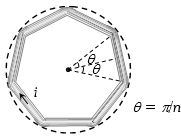
In the following figure a wire bent in the form of a regular polygon of $n$ sides is inscribed in a circle of radius $a$. Net magnetic field at centre will be
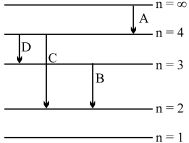
Consider the following electronic energy level diagram of $H-$ atom: Photons associated with shortest and longest wavelengths would be emitted from the atom by the transitions labelled:
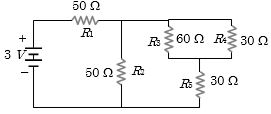
In circuit shown below, the resistances are given in $ohms$ and the battery is assumed ideal with emf equal to $3\, volt$. The voltage across the resistance $R_4$ is ................. $V$
A dense collection of equal number of electrons and positive ions is called neutral plasma. Certain solids containing fixed positive ions surrounded by free electrons can be treated as neutral plasma. Let ' $N$ ' be the number density of free electrons, each of mass ' $m$ '. When the electrons are subjected to an electric field, they are displaced relatively away from the heavy positive ions. If the electric field becomes zero, the electrons begin to oscillate about the positive ions with a natural angular frequency ' $\omega_p$ ', which is called the plasma frequency. To sustain the oscillations, a time varying electric field needs to be applied that has an angular frequency $\omega$, where a part of the energy is absorbed and a part of it is reflected. As $\omega$ approaches $\omega_{ p }$, all the free electrons are set to resonance together and all the energy is reflected. This is the explanation of high reflectivity of metals.

$1.$ Taking the electronic charge as ' $e$ ' and the permittivity as ' $\varepsilon_0$ ', use dimensional analysis to determine the correct expression for $\omega_p$.

$(A)$ $\sqrt{\frac{N e}{m \varepsilon_0}}$ $(B)$ $\sqrt{\frac{m \varepsilon_0}{N e}}$ $(C)$ $\sqrt{\frac{N e^2}{m \varepsilon_0}}$ $(D)$ $\sqrt{\frac{m \varepsilon_0}{N e^2}}$

$2.$ Estimate the wavelength at which plasma reflection will occur for a metal having the density of electrons $N \approx 4 \times 10^{27} m ^{-3}$. Take $\varepsilon_0 \approx 10^{-11}$ and $m \approx 10^{-30}$, where these quantities are in proper $SI$ units.

$(A)$ $800 \ nm$ $(B)$ $600 \ nm$ $(C)$ $300 \ nm$ $(D)$ $200 \ nm$

Give the answer question $1$ and $2.$ 
A very small magnet is placed in the magnetic meridian with its south pole pointing north. The null point is obtained $20\, cm $ away from the centre of the magnet. If the earth's magnetic field (horizontal component) at this point be $0.3$ $gauss$, the magnetic moment of the magnet is
A metal block is exposed to beams of X-ray of different wavelength. X-rays of which wavelength penetrate most
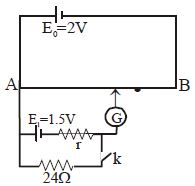
For the arrangement of the potentiometer shown in the figure, the balance point is obtained at $a$ distance $75\,cm $ from $A$ when the key $k$ is open. The second balance point is obtained at $60\, cm$ from $A$ when the key $k$ is closed. Find the internal resistance (in $ \Omega$) of the battery $E_1$.
Mark the correct options:
A telescope has an objective lens of $10\, cm$ diameter and is situated at a distance of $1\, km$ from two objects. The minimum distance between these two objects which can be resolved by the telescope, when the mean wavelength of light is $5000\,\mathop A\limits^o $, is the order of