Question
Account for the following:
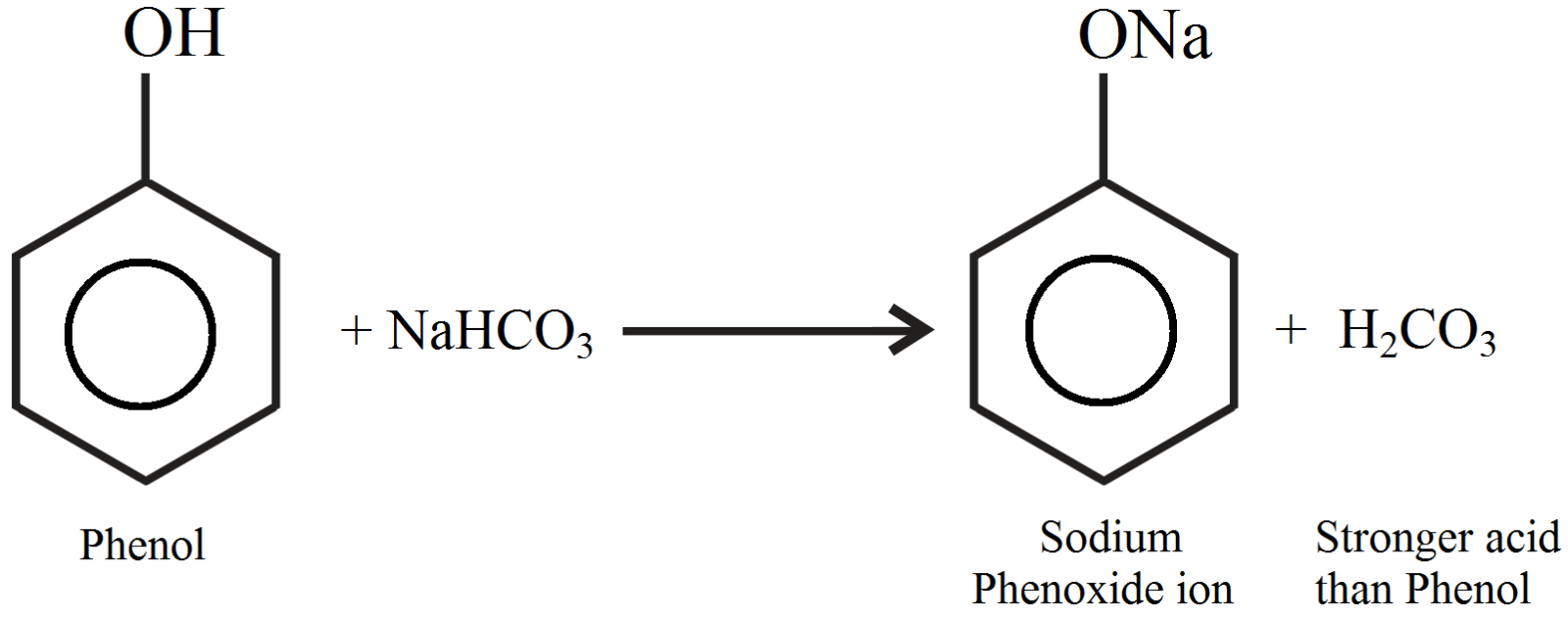
  1. Phenol does not react with $NaHCO_3$ whereas carboxylic acids react.
  2. Phenol is more easily nitrated than benzene.
Answer

  1. $\text{RCOOH}+\text{NaHCO}_3\xrightarrow{ \ \ \ \ \ \ \ \ \ }\text{RCOONa}+\text{H}_2\text{CO}_3\\ \ \ \ \ \ \ \ \ \ \ \ \ \ \ \ \ \ \ \ \ \ \ \ \ \ \ \ \ \ \ \ \ \ \ \ \ \ \ \ \ \ \ \ \ \ \ \ \ \ \ \ \ \ \ \ \ \ \ \ \ \ \ \ \text{Weaker acid}\\ \ \ \ \ \ \ \ \ \ \ \ \ \ \ \ \ \ \ \ \ \ \ \ \ \ \ \ \ \ \ \ \ \ \ \ \ \ \ \ \ \ \ \ \ \ \ \ \ \ \ \ \ \ \ \ \ \ \ \ \ \ \ \ \text{than RCOOH}$

Such acid-base reaction takes place only if the acid formrd is weaker than the reacting acid. In other words, phenol is not a strong enough acid to react with $NaHCO_3.$
  1. Nitration involves attack of electrophile nitronium ion $\stackrel{{+ \ \ \ }}{\hbox{ NO}_2}$ on benzene ring. Due to $+R$ effect of $-OH$ group electron density on benzene increases. Therefore, phenol is more easily nitrated as compared to benzene.

Need a full question paper?

Generate a complete, print-ready paper with questions like this in minutes — across 16+ boards, with answer keys.

Start Generating Free