Question
Accuracy of measurement is determined by
Generate a complete, print-ready paper with questions like this in minutes — across 16+ boards, with answer keys.
| List-$I$ | List-$II$ |
| $E$ is independent of $d$ | A point charge $Q$ at the origin |
| $E \propto \frac{1}{d}$ | A small dipole with point charges $Q$ at $(0,0, l)$ and $- Q$ at $(0,0,-l)$. Take $2 l \ll d$. |
| $E \propto \frac{1}{d^2}$ | An infinite line charge coincident with the x-axis, with uniform linear charge density $\lambda$ |
| $E \propto \frac{1}{d^3}$ | Two infinite wires carrying uniform linear charge density parallel to the $x$-axis. The one along ( $y=0$, $z =l$ ) has a charge density $+\lambda$ and the one along $( y =0, z =-l)$ has a charge density $-\lambda$. Take $2 l \ll d$ |
| plane with uniform surface charge density |
($1$) If the collision occurs at time $t_0=0$, the value of $v_{ cm } /(a \omega)$ will be
($2$) If the collision occurs at time $t_0=\pi /(2 \omega)$, then the value of $4 b^2 / a^2$ will be
Give the answer or quetion ($1$) and ($2$)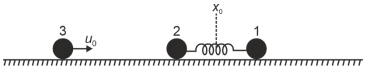
$(i)$ reading and
$(ii)$ for seeing distant stars are