MCQ
Acetaldehyde can be converted into $\begin{array}{*{20}{c}}
  {\,\,\,\,\,\,\,\,\,\,\,\,\,\,\,\,\,\,\,\,\,\,\,\,\,\,\,C{H_2}OH} \\ 
  {\,\,\,\,\,\,\,\,\,\,\,|} \\ 
  {HO\, - \,C{H_2} - C - C{H_2}OH} \\ 
  {\,\,\,\,\,\,\,\,\,\,\,|} \\ 
  {\,\,\,\,\,\,\,\,\,\,\,\,\,\,\,\,\,\,\,\,\,\,\,\,\,\,\,\,\,\,C{H_2}OH} 
\end{array}$ by which reagent ?
  • A
    $KOH$
  • B
    $KOH$ followed by $LAH$
  • excess of $HCHO$ and $KOH$
  • D
    $KCN$ followed by $SBH$

Answer

Correct option: C.
excess of $HCHO$ and $KOH$
c

Need a full question paper?

Generate a complete, print-ready paper with questions like this in minutes — across 16+ boards, with answer keys.

Start Generating Free

Similar questions

The most unlikely representation of resonance structures of $p-$ nitrophenoxide ion is
The reaction $2 NO + Br _2 \rightarrow 2 NOBr$

takes places through the mechanism given below :

$NO + Br _2 \Leftrightarrow NOBr _2 \text { (fast) }$

$NOBr _2+ NO \rightarrow 2 NOBr \text { (slow) }$

The overall order of the reaction is $.....$.

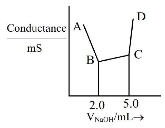
40 mL of a mixture of $\mathrm{CH}_{3} \mathrm{COOH}$ and HCl (aqueous solution) is titrated against 0.1 M NaOH solution conductometrically. Which of the following statement is correct?
Image
Vapour pressure of a solution of $5\,g$ of non- electrolyte in $100\,g$ of water at a particular temperature is $2985\,N/{m^2}$. The vapour pressure of pure water is $3000N/{m^2}$. The molecular weight of the solute is
Which of the following compounds of boron does not exist in the free form
$C{H_3}COOH\mathop {\xrightarrow{\Delta }}\limits_{{P_2}{O_5}} X$ . Identify $X$
Ethylene oxide when treated with Grignard reagent yields
$25\,g$ of a solute of molar mass $250\,g\,mol^{-1}$ is dissolved in $100\,ml$ of water to obtain a solution whose density is $1.25\,g\,ml^{-1}$. The molarity and molality of the solution are respectively
$Zn\,(s)\, + \,2AgCl\,(s)\, \to \,Z{n^{ + 2}}\,(aq)\, + 2Ag(s)\, + 2C{l^ - }(aq)$ will take place in
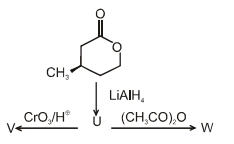
With reference to the scheme given, which of the given statments$(s)$ about $T , U , V$ and $W$ is (are) correct?

$(A)$ $T$ is soluble in hot aqueous $NaOH$

$(B)$ $U$ is optically active

$(C)$ Molecular formula of $W$ is $C _{10} H _{18} O _4$

$(D)$ $V$ gives effervescence on treatment with aqueous $NaHCO _3$