MCQ
Acetaldehyde reacts with ${C_2}{H_5}MgCl$ the final product is
  • A
    An aldehyde
  • B
    A ketone
  • C
    A primary alcohol
  • A secondary alcohol

Answer

Correct option: D.
A secondary alcohol
d
It's Obvious.

Need a full question paper?

Generate a complete, print-ready paper with questions like this in minutes — across 16+ boards, with answer keys.

Start Generating Free

Similar questions

Assertion : In Young's double slit experiment the two slits are at distance $d$ apart. Interference pattern is observed on a screen at distance $D$ from the slits. At a point onthe screen when it is directly opposite to one of the slits, a dark fringe is observed. Then, the wavelength of wave is proportional to square of distance of two slits

Reason : For a dark fringe intensity is zero.
Young's modules of material of a wire of length ' $L$ ' and cross-sectional area $A$ is $Y$. If the length of the wire is doubled and cross-sectional area is halved then Young's $modules$ will be :
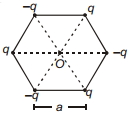
Six point charges are placed at the vertices of a regular hexagon of side $a$ as shown. If $E$ represents electric field and $V$ represents electric potential at $O$, then
The light rays having photons of energy $4.2\,eV$ are falling on a metal surface having a work function of $2.2\,eV$. The stopping potential of the surface is $.........\,V$
A ring of a thin wire of cross-sectional area a and length $l$ is dipped into a liquid of surface tension $\sigma$ and taken out so that a film of liquid is formed in the ring. If young's modulus of material of wire is $Y$ then longitudinal strain developed in the ring will. be
The number of turns and radius of cross-section of the coil of a tangent galvanometer are doubled. The reduction factor $K $ will be
According to kinetic theory of gases, which of following statement will be true.
The work done in doubling the radius of a soap bubble of radius $2\,cm$ will be ( $S.T.$ of soap solution $= 30\,dyne/cm$ )
An achromatic combination of lenses is formed by joining
A certain metallic surface is illuminated with monochromatic light of wavelength, $\lambda$. The stopping potential for photo-electric current for this light is $3 V_0$  . If the same surface is illuminated with light of wavelength $2\lambda$, the stopping potential is $V_0$. The threshold wavelength for this surface for photo- electric effect is