MCQ
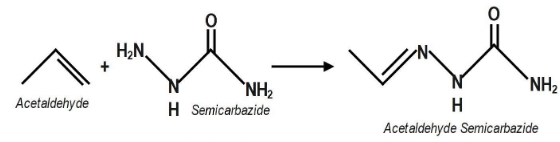
Acetaldehyde reacts with semicarbazide product will be
  • $ CH_3CH = NNHCONH_2$
  • B
     $CH_3CH = NCONHNH_2$
  • C
    $CH_3CH = NHNH_2$
  • D
    $\,\begin{array}{*{20}{c}}
      {C{H_3} - C - NH - CON{H_2}} \\ 
      {||\,\,\,\,\,\,\,\,\,\,\,\,\,\,\,\,\,\,\,\,\,\,\,\,\,\,\,\,\,} \\ 
      {O\,\,\,\,\,\,\,\,\,\,\,\,\,\,\,\,\,\,\,\,\,\,\,\,\,\,\,\,\,\,} 
    \end{array}$
Answer

Correct option: A.
$ CH_3CH = NNHCONH_2$
a
Acetaldehyde semicarbazone belongs to the group of semicarbazones. Semicarbazones are formed by the condensation reaction between an aldehyde or ketone and semicarbazide. A condensation reaction proceeds with the loss of a water molecule. So, to form acetaldehyde semicarbazone, we need to do the condensation reaction of aldehyde, which is acetaldehyde here, with semicarbazide. Semicarbazide is a derivative of urea.

Some semicarbazones have antiseptic properties. Nitrofurazone (trade name as Furacin) is such an example. Thiosemicarbazone is a semicarbazone which contains sulphur atoms (thio group) in the place of oxygen atoms. It possesses anti-viral, anti-malarial and anti-cancer activities.

Need a full question paper?

Generate a complete, print-ready paper with questions like this in minutes — across 16+ boards, with answer keys.

Start Generating Free

Similar questions

Ethyl bromide reacts with silver nitrite to form
Which one of the following compounds will give orange precipitate when treated with $2,4-$ dinitrophenyl hydrazine?
A heat engine absorbs heat ${Q_1}$ at temperature ${T_1}$ and heat ${Q_2}$ at temperature ${T_2}$. Work done by the engine is $({Q_1} + {Q_2})$. This data
Wavenumber for a radiation having $5800 \mathring A$ wavelength is $x \times 10 \mathrm{~cm}^{-1}$. The value of $x$ is. . . . . . . . 
The oxidation state of sulphur in $SO_4^{2 - }$ is
Strongest acid is
An aqueous solution ox $X$ is added slowly to an aqueous solution of $Y$ as shown in list $I$. The variation in conductivity of these reactions is given in List $II$. Match List $I$ with List $II$ and select the correct answer using the code given below the lists :

List $I$ List $II$
$P$. $\quad \underset{X}{\left( C _2 H _5\right)_3 N }+\underset{ Y }{ CH _3 COOH }$ $1.$ Conductivity decreases and then increases
$Q.$ $\quad \underset{X}{ KI (0.1 M )}+\underset{ Y }{ AgNO _3(0.01 M )}$ $2.$ Conductivity decreases and then does not change much
$R.$ $\quad \underset{X}{ CH _3 COOH }+\underset{ K }{ KOH }$ $3.$ Conductivity increases and then does not change much
$S$. $\quad \underset{X}{ NaOH }+\underset{Y}{ HI }$ $4.$ Conductivity does not change much and then increases

Codes: $ \quad P \quad Q \quad R \quad S $ 

Major product ' $B$ ' of the following reaction sequence is.
If one mole of a substance is present in $1\,kg$ of solvent, then
Which of the following is the least stable conformer of cyclohexane ?