MCQ
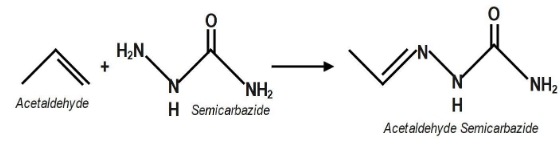
Acetaldehyde reacts with semicarbazide product will be
  • $ CH_3CH = NNHCONH_2$
  • B
     $CH_3CH = NCONHNH_2$
  • C
    $CH_3CH = NHNH_2$
  • D
    $\,\begin{array}{*{20}{c}}
      {C{H_3} - C - NH - CON{H_2}} \\ 
      {||\,\,\,\,\,\,\,\,\,\,\,\,\,\,\,\,\,\,\,\,\,\,\,\,\,\,\,\,\,} \\ 
      {O\,\,\,\,\,\,\,\,\,\,\,\,\,\,\,\,\,\,\,\,\,\,\,\,\,\,\,\,\,\,} 
    \end{array}$
Answer

Correct option: A.
$ CH_3CH = NNHCONH_2$
a
Acetaldehyde semicarbazone belongs to the group of semicarbazones. Semicarbazones are formed by the condensation reaction between an aldehyde or ketone and semicarbazide. A condensation reaction proceeds with the loss of a water molecule. So, to form acetaldehyde semicarbazone, we need to do the condensation reaction of aldehyde, which is acetaldehyde here, with semicarbazide. Semicarbazide is a derivative of urea.

Some semicarbazones have antiseptic properties. Nitrofurazone (trade name as Furacin) is such an example. Thiosemicarbazone is a semicarbazone which contains sulphur atoms (thio group) in the place of oxygen atoms. It possesses anti-viral, anti-malarial and anti-cancer activities.

Need a full question paper?

Generate a complete, print-ready paper with questions like this in minutes — across 16+ boards, with answer keys.

Start Generating Free