MCQ
Action and reaction:
  1. Act on two different objects.
  2. Have equal magnitude.
  3. Have opposite directions.
  4. Have resultant zero.
  • A
    Only $A$
  • B
    $A$ and $B$
  • C
    $B$ and $D$
  • All of the above

Answer

Correct option: D.
All of the above

The two forces $\overrightarrow{\text{F}}$ and $-\overrightarrow{\text{F}}$ connected by Newton's third law are known as action-reaction pair.
For example, when a man jumps out from a ferry, he applied some force on the ferry. So, the action force in this case is the force applied by the man and the reaction is the force exerted by the ferry on the man. Both the forces act upon different objects $($the man and the ferry$)$ but have equal magnitudes and opposite directions. As a result, their resultant is zero.

Need a full question paper?

Generate a complete, print-ready paper with questions like this in minutes — across 16+ boards, with answer keys.

Start Generating Free

Similar questions

A cube of external dimension $10\  cm$ has an inner cubical portion of side $5\  cm$ whose density is twice that of the outer portion. If this cube is just floating in a liquid of density $2\  g/cm^3$, find the density of the inner portion
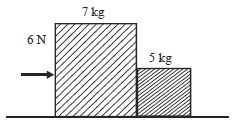
Two block of masses $7\, kg$ and $5\, kg$ are placed in contact with each other on a smooth surface. If a force of $6\, N$ is applied on the heavier mass, the force on the lighter mass is ............ $N$
The scale on a steel meter rod is calibrated at $20^\circ C.$ What will be the error in the reading of $50\ cm$ at $27^\circ C?$ Take, $\alpha=1.2\times10^{-5}\ ^\circ\text{C}^{-1}.$
The displacement $x$ of a particle depend on time $t$ as $x = \alpha {t^{^2}} - \beta {t^3}$ 
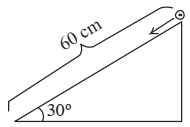
A solid cylinder is released from rest from the top of an inclined plane of inclination $30^{\circ}$ and length $60\,cm$. If the cylinder rolls without slipping, its speed upon reaching the bottom of the inclined plane is $...........ms ^{-1}$. (Given $g =10\,ms ^{-2}$)
An aeroplane flying $490 \,m$ above ground level at $100\, m/s$, releases a block. How far on ground will it strike ......... $km$
What are the units of $K = 1/4\pi {\varepsilon _0}$
For free expansion of the gas which of the following is true
Different processes are given in Column - $\mathrm{I}$ and its reasons are given in Column - $\mathrm{II}$. Match the appropriately.
Column - $\mathrm{I}$ Column - $\mathrm{II}$
$(a)$Rain drops moves downwards with constant velocity. $(i)$ Viscous liquids
$(b)$ Floating clouds at a height in air. $(ii)$ Viscosity
    $(iiii)$ Less density
An object is projected in the air with initial velocity $u$ at an angle $\theta$. The projectile motion is such that the horizontal range $R$, is maximum. Another object is projected in the air with a horizontal range half of the range of first object. The initial velocity remains same in both the case. The value of the angle of projection, at which the second object is projected, will be $.......$ degree.