Question
Action and reaction:
  1. Act on two different objects.
  2. Have equal magnitude.
  3. Have opposite directions.
  4. Have resultant zero.

Answer

  1. Act on two different objects.
  2. Have equal magnitude.
  3. Have opposite directions.
  4. Have resultant zero.

Explanation:

The two forces $\overrightarrow{\text{F}}$ and $-\overrightarrow{\text{F}}$ connected by Newton's third law are known as action-reaction pair.

For example, when a man jumps out from a ferry, he applied some force on the ferry. So, the action force in this case is the force applied by the man and the reaction is the force exerted by the ferry on the man. Both the forces act upon different objects (the man and the ferry) but have equal magnitudes and opposite directions. As a result, their resultant is zero.

Need a full question paper?

Generate a complete, print-ready paper with questions like this in minutes — across 16+ boards, with answer keys.
Start Generating Free

Similar questions

$A$ particle of mass $3m$ is projected from the ground at some angle with horizontal. The horizontal range is $R$. At the highest point of its path it breaks into two pieces $m$ and $2m$. The smaller mass comes to rest and larger mass finally falls at a distance $x$ from the point of projection where $x$ is equal to
A pressure cooker contains air at $1$ atm and $30^o C$. If the safety value of the cooler blows when the inside pressure $ \ge 3$ atm, then the maximum temperature of the air, inside the cooker can be .... $^oC$
A uniform plank of Young’s modulus $Y $ is moved over a smooth horizontal surface by a constant horizontal force $F.$ The area of cross section of the plank is $A.$ The compressive strain on the plank in the direction of the force is
Let kinetic energy of a satellite is $x$, then its time of revolution $T$ is proportional to ..............
Two particles A and B initially at rest, move towards each other, under mutual force of attraction. At an instance when the speed of A is v and speed of B is 2v, the speed of centre of mass (CM) is:
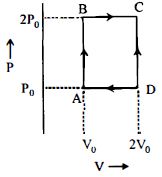
An engine operates by taking $n\,moles$ of an ideal gas through the cycle $ABCDA$ shown in figure. The thermal efficiency of the engine is : (Take $C_v =1 .5\, R$, where $R$ is gas constant)
What should be the angular speed with which the earth have to rotate on its axis so that a person on the equator would weigh $\frac{3}{5}$ th as much as present?
If T is the surface tension of soap solution, the amount of work done in blowing a soap bubble from a diameter D to a diameter 2D is:
Work done in splitting a drop of water of $1 \,mm $ radius into $10^6$ droplets is (Surface tension of water $ = 72 \times {10^{ - 3}}J/{m^2})$
The pressure P of a gas and its mean K.E. per unit volume are related as: