MCQ
Action and reaction forces act on
  • A
    The same body
  • The different bodies
  • C
    The horizontal surface
  • D
    Nothing can be said

Answer

Correct option: B.
The different bodies
b
(b) According to Newton's third law, action and reaction forces act simultaneously but on different bodies.

Need a full question paper?

Generate a complete, print-ready paper with questions like this in minutes — across 16+ boards, with answer keys.

Start Generating Free

Similar questions

Excess pressure of one soap bubble is four times more than the other. Then the ratio of volume of first bubble to another one is
A body performs $S.H.M.$ Its kinetic energy $K$ varies with time $t$ as indicated by graph
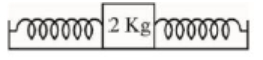
A block of mass $2\,kg$ is attached with two identical springs of spring constant $20\,N / m$ each. The block is placed on a frictionless surface and the ends of the springs are attached to rigid supports (see figure). When the mass is displaced from its equilibrium position, it executes a simple harmonic motion. The time period of oscillation is $\frac{\pi}{\sqrt{x}}$ in SI unit. The value of $x$ is $..........$
A metal bal of mass $0.1\, kg$ is heated upto $500\,{}^oC$ and dropped into a vessel of heat capacity $800\, JK^{-1}$ and containing $0.5\, kg$ water. The initial temperature of water and vessel is $30\,{}^oC$. ........ $\%$ is the approximate percentage increment in the temperature of the water. [Specific heat Capacities of water and metal are, respectively $4200\, Jkg^{-1}K^{-1}$ and $400\, Jkg^{-1}K^{-1}$]
The temperature on Celsius scale is $25°C$. What is the corresponding temperature on the Fahrenheit scale........ $^oF$
A rod elongates by l when a body of mass M is suspended from it. The work done is:
The vapour of a substance behaves as a gas
The total radiant energy per unit area, normal to the direction of incidence, received at a distance $R$ from the centre of a star of radius $r$, whose outer surface radiates as a black body at a temperature $T\ K$ is given by
An object is projected vertically up from the earth's surface with velocity $\sqrt {Rg}$ where $R$ is the radius of the earth and $'g'$ is the acceleration due to earth on the  surface of earth. Find the maximum height reached by the object.
A car moves for 60s covering a distance of 3600m with zero initial velocity. What is the acceleration in m/ s2?