Question
After how many seconds will the concentration of the reactants in a first order reaction be halved, if the decay constant is ${\rm{1}}{\rm{.155}} \times {\rm{1}}{{\rm{0}}^{{\rm{ - 3}}}}\,{\sec ^{ - 1}}$ ........... $\sec$

Answer

$t = \frac{{2.303}}{k}\log \frac{a}{{a - x}}$

$t = \frac{{2.303}}{{1.155 \times {{10}^{ - 3}}}}\log \frac{{100}}{{100 - 50}} = 600\,\sec $

Need a full question paper?

Generate a complete, print-ready paper with questions like this in minutes — across 16+ boards, with answer keys.

Start Generating Free

Similar questions

A $2.0 \,g$ sample containing $MnO _{2}$ is treated with $HCl$ liberating $Cl _{2}$. The $Cl _{2}$ gas is passed into a solution of $KI$ and $60.0\, mL$ of $0.1\, M\, Na _{2} S _{2} O_{3}$ is required to titrate the liberated iodine. The percentage of $MnO _{2}$ in the sample is $.....$ (Nearest integer)

[Atomic masses (in $u$) $Mn =55 ; Cl =35.5 ; O =16, I =127, Na =23, K =39, S =32]$

Catalyst $A$ reduces the activation energy for a reaction by $10\, k\,J\, mol ^{-1}$ at $300\, K$. The ratio of rate $\frac{ k _{ T }, \text { Catalysed }}{ k _{ T }, \text { Uncatalysed }}$ is $e ^{ x }$ [nearest integer $]$

[Assume theat the pre-exponential factor is same in both the cases.

Given $R =8.31 \,J\, K ^{-1} \,mol ^{-1}$ ]

A first order reaction has the rate constant, $k =4.6$ $\times 10^{-3} s ^{-1}$. The number of correct statement/s from the following is/are

Given : $\log 3=0.48$

$A.$ Reaction completes in $1000\,s$.

$B.$ The reaction has a half-life of $500\, s$.

$C.$ The time required for $10\, \%$ completion is 25 times the time required for $90 \,\%$ completion.

$D.$ The degree of dissociation is equal to $\left(1-e^{-k t}\right)$.

$E.$ The rate and the rate constant have the same unit.
$A ( g ) \rightarrow 2 B ( g )+ C ( g )$ is a first order reaction. The initial pressure of the system was found to be $800\,mm\,Hg$ which increased to $1600\,mm\,Hg$ after $10\,min$. The total pressure of the system after $30\,min$ will be $.........\,mm\,Hg$. (Nearest integer)
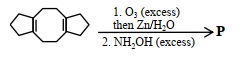
In the reaction given below, the total number of atoms having $s p^2$ hybridization in the major product $P$ is. . . . . 
The rate of certain reaction depends on concentration according to the equation $\frac{{ - dc}}{{dt}}\, = \,\frac{{{K_1}C}}{{1 + {K_2}C}},$ what is the order, when concentration $(c)$ is very-very high
The number of $N$ atoms is $681 \,g$ of $C _{7} H _{5} N _{3} O _{6}$ is $x \times 10^{21}$. The value of $x$ is $.....$ $\left( N _{ A }=6.02 \times\right.$ $10^{23}\, mol ^{-1}$ ) (Nearest Integer)
A reaction of $0.1$ mole of Benzylamine with bromomethane gave $23\, g$ of Benzyl trimethyl ammonium bromide. The number of moles of bromomethane consumed in this reaction are $n \times 10^{-1},$ when $n =\ldots...$ (Round off to the Nearest Integer).

(Given : Atomic masses: $C$ : $12.0\, u$, $H : 1.0\, u , N : 14.0\, u , Br : 80.0\, u ]$

The homoleptic and octahedral complex of $Co ^{2+}$ and $H _2 O$ has $.......$ unpaired electron(s) in the $t _{2 g }$ set of orbitals.
$0.8\, \mathrm{~g}$ of an organic compound was analysed by Kjeldahl's method for the estimation of nitrogen. If the percentage of nitrogen in the compound was found to be $42\, \%$, then $....\,\mathrm{mL}$ of $1\, \mathrm{M}$ $\mathrm{H}_{2} \mathrm{SO}_{4}$ would have been neutralized by the ammonia evolved during the analysis.