MCQ
After one $\alpha $ and two $\beta $ emissions
  • A
    Mass number reduces by $3$
  • Mass number reduces by $ 4$
  • C
    Mass number reduces by $6$
  • D
    Atomic number remains unchanged

Answer

Correct option: B.
Mass number reduces by $ 4$
b
(b) $_{Z}{{X}^{A}}{{\xrightarrow{\alpha }}_{Z-2}}{{Y}^{A-4}}{{\xrightarrow{2\beta }}_{Z}}{{X}^{A-4}}$

Need a full question paper?

Generate a complete, print-ready paper with questions like this in minutes — across 16+ boards, with answer keys.
Start Generating Free

Similar questions

A semiconductor having electron and hole motilities $\mu_{ n }$ and $\mu_{ p }$ respectively. if its intrinsic carrier density is $n _{ i }$, then what will be the value of hole concentration $P$ for which the conductivity will be minimum at a given temperature?
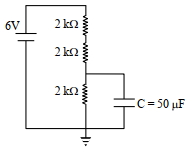
A capacitor of $50 \,\mu {F}$ is connected in a circuit as shown in figure. The charge on the upper plate of the capacitor is $......\,\mu {C} .$
Two slits in Young's experiment have widths in the ratio $1 : 25.$ The ratio of intensity at the maxima and minima in the interference pattern, $\frac{I_{max}}{I_{min}}$ is
The subatomic particle that is emitted from a metal surface, when it is heated is a/an $........$:
In hydrogen atom, the electron is making $6.6 \times 10^{15} \mathrm{rev} / \mathrm{sec}$ around the nucleus in an orbit of radius 0.528 Å. The magnetic moment $\left(A-m^2\right)$ will be
Let $\mathrm{F}_{\mathrm{pp}}, \mathrm{F}_{\mathrm{pn}}$ and $\mathrm{F}_{\mathrm{nn}}$ denote the magnitudes of the net force by a proton on a proton, by a proton on a neutron and by a neutron on a neutron respectively. Neglect gravitational force. When the separation is $1 fm :$
A neutral spherical copper particle has a radius of $10 \,nm \left(1 \,nm =10^{-9} \,m \right)$. It gets charged by applying the voltage slowly adding one electron at a time. Then, the graph of the total charge on the particle versus the applied voltage would look like
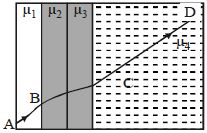
A ray of light passes through four transparent media with refractive indices $μ_1$, $μ_2$, $μ_3$ and $μ_4$ as shown in the figure. The surfaces of all media are parallel. If the emergent ray $CD$ is parallel to the incident ray $AB$, we must have
A coil of self inductance $10\,mH$ and resistance $0.1\,\Omega $ is connected through a switch to a battery of internal resistance $0.9\,\Omega $. After the switch is closed the time taken for the current to attain $80\%$ of the saturation values is: [take $ln\,5 = 1.6$ ]
An accident in a nuclear laboratory resulted in deposition of a certain amount of radioactive material of half-life $18$ days inside the laboratory. Tests revealed that the radiation was $64$ times more than the permissible level required for safe operation of the laboratory. What is the minimum number of days after which the laboratory can be considered safe for use?