MCQ
Agarose is a polymer of:
- AGlucose
- BAgarobiose
- CPolyacrylamide
- DBisacrylamide
Explanation:
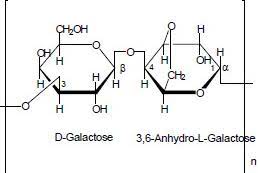
Agarose is a polymer of agarobiose.
Agarose:- Agarose is a polysaccharide, generally extracted from certain red seaweed.
It is a linear polymer made up of the repeating unit of agarobiose, which is a disaccharide made up of D - galactose and 3, 6 - anhydro - L - galactopyranose.
Generate a complete, print-ready paper with questions like this in minutes — across 16+ boards, with answer keys.
$A$. All group $16$ elements form oxides of general formula $\mathrm{EO}_2$ and $\mathrm{EO}_3$ where $\mathrm{E}=\mathrm{S}, \mathrm{Se}, \mathrm{Te}$ and Po. Both the types of oxides are acidic in nature.
$B$. $\mathrm{TeO}_2$ is an oxidising agent while $\mathrm{SO}_2$ is reducing in nature.
$C$. The reducing property decreases from $\mathrm{H}_2 \mathrm{~S}$ to $\mathrm{H}_2 \mathrm{Te}$ down the group.
$D$. The ozone molecule contains five lone pairs of electrons.
Choose the correct answer from the options given below:
$Cl_2(aq) + H_2S(aq) \to S(s) + 2H^+(aq) + 2Cl^-(aq)$
The rate equation for this reaction is rate $= k[Cl_2][H_2S]$ Which of these mechanisms is/are consistent with this rate equation ?
$A.\,C{l_2} + {H_2}S \to {H^ + } + C{l^ - } + C{l^ + } + H{S^- }$ (slow)
$C{l^ + } + H{S^ - } \to {H^ + } + C{l^ - } + {S}$ (fast)
$B.\, H_2S \Leftrightarrow H^+ + HS^-$ (fast equilibrium)
$Cl_2 + HS^-\to 2Cl^-+ H^+ + S$ (slow)