MCQ
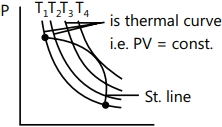
Agas expands such that its initial and final temperature are equal. Also, the process followed by the gas traces a straight line on the $P-V$ diagram :
  • A
    The temperature of the gas remains constant throughout.
  • B
    The temperature of the gas first increases and then decreases
  • C
    The stright line has a negative slope.
  • both $(B)$ and $(C)$

Answer

Correct option: D.
both $(B)$ and $(C)$
d
The slope of straight line can't be tve. since, $\mathrm{T} \propto \mathrm{PV}$ and if slope is $+ve$, then both $\mathrm{P}$ and $\mathrm{V}$ are increasing. Therefore, temperature will always increase.

$\mathrm{T}_{1}<\mathrm{T}_{2}<\mathrm{T}_{3}<\mathrm{T}_{4}$

Thus, from graph it can be seen, that temperature first increases and then decrease.

Need a full question paper?

Generate a complete, print-ready paper with questions like this in minutes — across 16+ boards, with answer keys.

Start Generating Free

Similar questions

When an electric dipole $\overrightarrow P $ is placed in a uniform electric field $\overrightarrow E $ then at what angle between $\overrightarrow P $ and $\overrightarrow E $ the value of torque will be maximum.......$^o$
A ray of light is incident from a denser to a rarer medium. The critical angle for total internal reflection is ${\theta _{iC}}$ and Brewster's angle of incidence is ${\theta _{iB}}$, such that $\sin \,{\theta _{iC}}/\sin \,{\theta _{iB}} = \eta  = 1.28$. The  relative refractive index of the two media is
Speed of light is maximum in
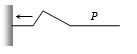
Figure here shows an incident pulse $P$ reflected from a rigid support. Which one of $A, B, C, D$ represents the reflected pulse correctly
A system performs work $\Delta W$ when an amount of heat is$\Delta Q$ added to the system, the corresponding change in the internal energy is $\Delta U$. A unique function of the initial and final states (irrespective of the mode of change) is
A charged particle of specific charge $\alpha$ is released from origin at time $t = 0$ with velocity $\vec V = {V_o}\hat i + {V_o}\hat j$ in magnetic field $\vec B = {B_o}\hat i$ . The coordinates of the particle at time $t = \frac{\pi }{{{B_o}\alpha }}$ are (specific charge $\alpha = \,q/m$) 
Three force $F_1=10\,N , F_2=8\,N , F _3=6\,N$ are acting on a particle of mass $5\,kg$. The forces $F _2$ and $F _3$ are applied perpendicular so that particle remains at rest. If the force $F_1$ is removed, then the acceleration of the particle is $......ms^{-2}$
Which two of the given transverse waves will give stationary waves when get superimposed

${z_1} = a\cos (kx - \omega \,t)$.....$(A)$

${z_2} = a\cos (kx + \omega \,t)$.....$(B)$

${z_3} = a\cos (ky - \omega \,t)$..... $(C)$

The potential energy of a system increases if work is done
Assuming photoemission to take place, the factor by which the maximum velocity of the emitted photoelectrons changes when the wavelength of the incident radiation is increased four times, is