MCQ
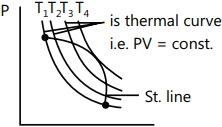
Agas expands such that its initial and final temperature are equal. Also, the process followed by the gas traces a straight line on the $P-V$ diagram :
  • A
    The temperature of the gas remains constant throughout.
  • B
    The temperature of the gas first increases and then decreases
  • C
    The stright line has a negative slope.
  • both $(B)$ and $(C)$

Answer

Correct option: D.
both $(B)$ and $(C)$
d
The slope of straight line can't be tve. since, $\mathrm{T} \propto \mathrm{PV}$ and if slope is $+ve$, then both $\mathrm{P}$ and $\mathrm{V}$ are increasing. Therefore, temperature will always increase.

$\mathrm{T}_{1}<\mathrm{T}_{2}<\mathrm{T}_{3}<\mathrm{T}_{4}$

Thus, from graph it can be seen, that temperature first increases and then decrease.

Need a full question paper?

Generate a complete, print-ready paper with questions like this in minutes — across 16+ boards, with answer keys.

Start Generating Free

Similar questions

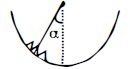
An insect crawls up a hemispherical surface very slowly. The coefficient of friction between the insect and the surface is $1/3$. If the line joining the centre of the hemispherical surface to the insect makes an angle $\alpha $ with the vertical, the maximum possible value of $\alpha $ so that the insect does not slip is given by
The relation between time and distance is $t = \alpha {x^2} + \beta x$, where $\alpha $ and $\beta $ are constants. The retardation is
The velocity of a particle moving on the $x-$ axis is given by $v = x^2 + x$ where $v$ is in $m/s$ and $x$ is in $m$ . Find its acceleration in $m/s^2$ when passing through the point $x = 2m$
If $W$ be the weight of a body of density $\rho $ in vacuum then its apparent weight in air of density $\sigma $ is
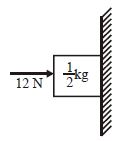
A horizontal force $12 \,N$ pushes a block weighing $1/2\, kg$ against a vertical wall.  The  coefficient of static friction between the wall and the block is $0.5$ and the coefficient of  kinetic friction is $0.35.$ Assuming that the block is not moving  initially. Which one of the following choices is correct (Take $g = 10 \,m/s^2$)
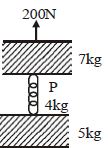
Two blocks of  $7\,\,kg$ and $5\,\,kg$  are connected by a heavy rope of mass $4\,\,kg.$ An upward force of $200\,N$  is applied as shown in the diagram. The tension at the top of heavy rope at point $P$  is ....... $N$ $(g = 10\,\,m/s^2)$
A standing wave pattern of amplitude $A$ in a string of length $L$ shows $2$ nodes (plus those at two ends). If one end of the string corresponds to the origin and $v$ is the speed of progressive wave, the disturbance in the string, could be represented (with appropriate phase) as: 
Gravitational potential in a region is given by $v=-(x+y+z) J / kg$. Find the gravitational intensity at $(2,2,2)$ is ........... $N / kg$
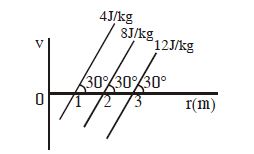
As gravitational potential versus distance $'r'$ graph is represented in figure. The magnitude of gravitational field intensity is equal to....... $N/kg$
A stone projected with a velocity u at an angle $\theta$ with the horizontal reaches maximum height $H_1$. When it is projected with velocity u at an angle $\left( {\frac{\pi }{2} - \theta } \right)$ with the horizontal, it reaches maximum height $ H_2$. The relation between the horizontal range R of the projectile, $H_1$ and $H_2$ is