MCQ
$AgCl$ precipitate dissolves in ammonia due to the formation of
  • A
    $[Ag{(N{H_4})_2}]OH$
  • B
    $[Ag{(N{H_4})_2}]Cl$
  • C
    $[Ag{(N{H_3})_2}]OH$
  • $[Ag{(N{H_3})_2}]Cl$

Answer

Correct option: D.
$[Ag{(N{H_3})_2}]Cl$
d
(d) $AgCl + N{H_3} \to \mathop {[Ag{{(N{H_3})}_2}]Cl\,\,\,\,\,\,\,\,}\limits_{{\text{Diammine silver (I) chloride}}} $

Need a full question paper?

Generate a complete, print-ready paper with questions like this in minutes — across 16+ boards, with answer keys.

Start Generating Free

Similar questions

What is the $pH$ of a $10^{-4}\, M\,OH^-$ solution at $330\,K$, if $K_w$ at $330\,K$ is $10^{-13.6}$ ?
In hydroboration reaction 
$I$. Syn addition takes place
$II$. Reaction proceed through formation of cyclic transition state
$III$. Markownikoff rule is followed in reaction
$IV$. Anti addition takes place and anti markownikoff rule is followed

Correct statement is/are

The product of following reaction is

$\begin{array}{*{20}{c}}
  {C{H_3}\,\,\,\,\,\,\,\,\,\,\,\,\,\,\,} \\ 
  {\,|\,\,\,\,\,\,\,\,\,\,\,\,\,\,\,\,\,\,\,\,\,\,\,} \\ 
  {C{H_3} - C - CH = C{H_2}\,\,\,\,\,} \\ 
  {\,|\,\,\,\,\,\,\,\,\,\,\,\,\,\,\,\,\,\,\,\,\,\,\,} \\ 
  {\,\,\,\,C{H_{3\,\,\,\,\,\,\,\,\,\,\,\,\,\,\,\,\,\,\,\,\,\,\,\,\,\,\,\,\,}}} 
\end{array}\xrightarrow[{(ii)\,NaB{H_4}}]{{(i)\,Hg{{(OAc)}_2};{H_2}O}}$

The enthalpy change at $298\,K$ for decomposition is given in the following two steps

Step $I\,\,:$ ${H_2}O(g)\, \to \,H(g)\, + \,OH(g)\,;$              $\Delta H = 498\,kJ\,mol^{-1}$

Step $II\,\,:$ $OH(g)\, \to \,H(g)\, + \,O(g)\,;$              $\Delta H = 428\,kJ\,mol^{-1}$

The bond enthalpy of the $O-H$ bond is....$kJ\,mol^{-1}$

cis and trans $ 2-$butene are
Select the final product from this sequence of reactions. 

Acetoacetic ester $\xrightarrow{NaOEt}$  $\xrightarrow{C{{H}_{3}}I}$  $\xrightarrow{NaOEt}$   $\xrightarrow{C{{H}_{3}}C{{H}_{2}}C{{H}_{2}}Br}$

Choose the $CORRECT$ reason for fluorine being a stronger oxidising agent than chlorine 

$(I)$ Low enthalpy of dissociation of $F-F$ bond

$(II)$ High hydration enthalpy of $F^-$

$(III)$ Low atomisation enthalpy of $F_2$

For the electrophilic substitution reaction involving sulphonation, which of the following sequence regarding the rate of reaction is true ?
Tertiary alkyl halides are practically inert to substitution by ${S_N}^2$ mechanism because of
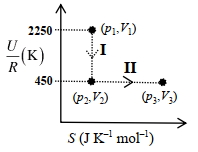
One mole of an ideal gas at $900 K$, undergoes two reversible processes, $I$ followed by $II$, as shown below. If the work done by the gas in the two processes are same, the value of $\ln \frac{V_3}{V_2}$ is. . . . . . . .  ( $U$ : internal energy, $S$ : entropy, $p$ : pressure, $V$ : volume, $R$ : gas constant) (Given: molar heat capacity at constant volume, $C_{V, m }$ of the gas is $\frac{5}{2} R$ )

( $U$ : आंतरिक ऊर्जा (internal energy), $S$ : एंट्रॉपी (entropy), $p$ : दाब (pressure), $V$ : आयतन (volume), $R$ : गैस नियतांक (gas constant)

(दिया गयाः स्थिर आयतन पर गैस की मोलर ऊष्माधारिता (molar heat capacity at constant volume), $C_{V, m }$ का मान $\frac{5}{2} R$ है)