MCQ
Albert Einstein got a nobel prize in physics for his work on:
  • A
    Special theory of relativity
  • B
    General theory of relativity
  • Photoelectric effect
  • D
    Theory of specific heats

Answer

Correct option: C.
Photoelectric effect

In $1905$, Albert Einstein extended Planck's hypothesis to explain the photoelectric effect, which is the emission of electrons by a metal surface when it is irradiated by light or more$-$energetic photons.

Need a full question paper?

Generate a complete, print-ready paper with questions like this in minutes — across 16+ boards, with answer keys.
Start Generating Free

Similar questions

If $N$ is the number of turns in a coil, the value of self-inductance varies as
Consider an electromagnetic wave propagating in vacuum. Choose the correct statement:
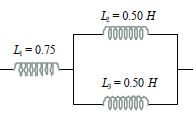
Three inductances are connected as shown below. Assuming no coupling, the resultant inductance will be.....$H$
The flux density obtained at the centre of a circular coil of radius $R$ which carries a current $i$, is $B_0$. At a distance $‘pR’$ from the centre on the axis, the flux density will be
A dielectric slab is inserted between the plates of a capacitor. The charge on the capacitor is Q and the magnitude of the induced charge on each surface of the dielectric is Q':
In a potentiometer experiment, the galvanometer shows no deflection when a cell is connected across 60 cm of the potentiometer wire. If the cell is shunted by a resistance of 6Ω, the balance is obtained across 50 cm of the wire. The internal resistance of the cell is
A coil of cross-sectional area  $A$ having $n$  turns is placed in a uniform magnetic field $B.$  When it is rotated with an angular velocity $\omega ,$  the maximum $e.m.f.$  induced in the coil will be
The dependence of binding energy per nucleon, $\mathrm{B}_{\mathrm{N}}$ on the mass number, A, is represented by
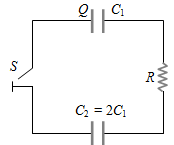
Two capacitors $\mathrm{C}_1$ and $\mathrm{C}_2=2 \mathrm{C}_1$ are connected in a circuit with a switch between them as shown in the figure. Initially the switch is open and $\mathrm{C}_1$ holds charge Q. The switch is closed. At steady state, the charge on each capacitor will be
In a cathode ray tube, what is the effect on the beam of particles if it passes through the electric field?