MCQ
Albert Einstein used corpuscular theory to explain:
  • A
    $E = mc^2$
  • The photoelectric effect
  • C
    Quantisation of charge
  • D
    Magic of light

Answer

Correct option: B.
The photoelectric effect

The photoelectric effect.
In $1905$, Albert Einstein published a paper in advancing hypothesis that the light energy $I'd$ being carried in discrete quantized packets to explain experimental data from photoelectric effect. This model contributed the development of quantum mechanics.
Photoelectric effect refers to the emission, or rejection of electrons grim the surface of generally a metal in response to the incident light.

Need a full question paper?

Generate a complete, print-ready paper with questions like this in minutes — across 16+ boards, with answer keys.

Start Generating Free

Similar questions

Assertion : A disc-shaped magnet is deviated above a superconducting material that has been cooled by liquid nitrogen.

Reason : Superconductors repel a magnet.
There exists a uniform electric field $E=4 \times 10^5 \,Vm ^{-1}$ directed along negative $x$-axis such that electric potential at origin is zero. Acharge of $-200 \,\mu C$ is placed at origin, and a charge of $+200 \,\mu C$ is placed at $(3 \,m , 0)$. The electrostatic potential energy of the system is ...........$J$
In photo-electric effect, when photons of energy ′hv′ are incident on a metal surface, electrons are emitted with some kinetic energy. It is possible to say that:
What is the effect on null deflection of galvanometer, when the radius of the wire is tripled?
An electron enters a region where electrostatic field is 20N/C and magnetic field is 5T. If electron passes undeflected through the region, then velocity of electron will be
When green light is incident on the surface of metal, it emits photo-electrons but there is no such emission with yellow colour light. Which one of the colour can produce emission of photo-electrons
When $10^{19}$ electrons are removed from a neutral metal plate, the electric charge on it is
A potentiometer has uniform potential gradient across it. Two cells connected in series $(i)$ to support each other and $(ii)$ to oppose each other are balanced over $6\,m$ and $2\,m$ respectively on the potentiometer wire. The $e.m.f.$’s of the cells are in the ratio of
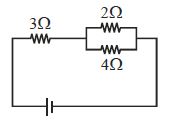
If power in $3\,\Omega $ is $27\,W$ then what is the power in $2\,\Omega $  ................ $\mathrm{W}$
Stars are twinkling due to