MCQ
Alcoholic solution of $KOH$ is used for
- ADehydration
- BDehydrogenation
- ✓Dehydrohalogenation
- DDehalogenation
In alcoholic $KOH$ alkoxide ions $(R{O^ - })$ are present which is a strong base. They abstract proton from ?-carbon of alkyl halide and favours elimination reaction
$\mathop {ROH}\limits_{{\rm{Alcohol}}} + KOH \to \mathop {ROK + {H_2}O}\limits_{{\rm{Potassium \,alkoxide}}} $
$ROK \to \mathop {R{O^ - }}\limits_{{\rm{Alkoxide \,ion}}} + {K^ + }$
$R{O^ - } + H - \mathop {C{H_2}}\limits^\beta - \mathop {C{H_2}}\limits^\alpha - Br \to ROH + C{H_2} = C{H_2} + Br$
Generate a complete, print-ready paper with questions like this in minutes — across 16+ boards, with answer keys.
$H - C\, \equiv CH\,\xrightarrow[{(ii)\,C{H_3}C{H_2}Br}]{{(i)\,NaN{H_2}\,/\,liq.\,N{H_3}}}\,X$
$\xrightarrow[{(ii)\,C{H_3}C{H_2}Br}]{{(i)\,NaN{H_2}\,/\,liq.\,N{H_3}}}\,Y$
$X$ and $Y$ are
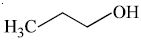
(image) $\mathop {\xrightarrow{{conc.{H_2}S{O_4}}}}\limits_{170^\circ C} X\mathop {\xrightarrow{{B{r_2}}}}\limits_{CC{l_4}} $ $Y\mathop {\xrightarrow{{alc.KOH}}}\limits_\Delta Z$