Question
$A=\left[\begin{array}{cc}3 & 1 \\ -1 & 2\end{array}\right]$, show that $A^2 - 5A + 7 I_2 = 0$.
Answer

We have
$A=\left[\begin{array}{cc}3 & 1 \\ -1 & 2\end{array}\right] $
$ A=\left[\begin{array}{cc}3 & 1 \\ -1 & 2\end{array}\right]\left[\begin{array}{cc}3 & 1 \\ -1 & 2\end{array}\right] $
$ =\left[\begin{array}{cc}9-1 & 3+2 \\ -3-2 & -1+4\end{array}\right] $
$ =\left[\begin{array}{cc}8 & 5 \\ -5 & 3\end{array}\right] \\ -5 A =\left[\begin{array}{cc}(-5) \cdot 3 & (-5) \cdot 1 \\ (-5) \cdot(-1) & (-5) \cdot 2\end{array}\right] $
$ =\left[\begin{array}{cc}-5 & -5 \\ 5 & -10\end{array}\right]$
$ -5 A =\left[\begin{array}{cc} (-5) \cdot 3 & (-5) \cdot 1 \\ (-5) \cdot(-1) & (-5) \cdot 2
\end{array}\right] $
$=\left[\begin{array}{cc} -5 & -5 \\ 5 & -10 \end{array}\right] 7 I _2 =7\left[\begin{array}{cc} 1 & 0 \\ 0 & 1 \end{array}\right]=\left[\begin{array}{ll} 7 & 0 \\ 0 & 7 \end{array}\right]$
So $A^2-5 A+71_2$
$=\left[\begin{array}{cr} 8 & 5 \\ -5 & 3 \end{array}\right]+\left[\begin{array}{cc} -15 & -5 \\ 5 & -10 \end{array}\right]+\left[\begin{array}{ll} 7 & 0 \\ 0 & 7 \end{array}\right] $
$=\left[\begin{array}{cc} 8-15+7 & 5-5+0 \\ -5+5+0 & 3-10+7 \end{array}\right]=\left[\begin{array}{ll} 0 & 0 \\
0 & 0 \end{array}\right]$
So $A^2 - 5A + 7I_2 = 0$.
Hence proved.

Need a full question paper?

Generate a complete, print-ready paper with questions like this in minutes — across 16+ boards, with answer keys.

Start Generating Free

Similar questions

Prove the following identity:
$
(1+\cot A+\tan A)(\sin A-\cos A)=\frac{\sec A}{\operatorname{cosec} 2}-\frac{\operatorname{cosec} A}{\sec ^2 A}
$
Given $x =\frac{\sqrt{a^2+b^2}+\sqrt{a^2-b^2}}{\sqrt{\wedge 2+b^2}-\sqrt{a^2-b^2}}$ Use componendo and dividendo to prove that $b ^2=\frac{2 a^2 x}{x^2+1}$
A(2,2) and B(5,5) are the vertices of a figure which is symmetrical about xaxis. Complete the figure and give its geometrical name. 
The length of a hall is $5 \ m$ more than the breadth. If the area of the floor of the hall is $84m2$, find the length and breadth of the hall.
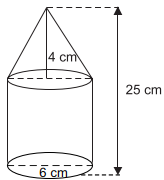
The given solid figure is a cylinder surmounted by a cone. The diameter of the base of the cylinder is 6 cm . The height of the cone is 4 cm and the total height of the solid is 25 cm . Take $\pi=\frac{22}{7}$. Find the :
(a) volume of the solid
(b) curved surface area of the solid
Give your answers correct to the nearest whole number
Image
Draw two concentric circles with radii 4 cm and 6 cm. Taking a point on the outer circle, construct a pair of tangents to inner circle. By measuring the lengths of both the tangents, show that they are equal to each other.
On what sum of money will the compound interest for $2 \frac{1}{2}$ years at $12 \%$ per annum amount to Rs $8,241.60 ?$
A buoy is made in the form of a hemisphere surmounted by a right circular cone whose circular base coincides with the plane surface of the hemisphere. The radius of the base of the cone is 3.5 m and its volume is two-third the volume of hemisphere. Calculate the height of the cone and the surface area of the buoy, correct to two decimal places. 
A canvas tent is in the shape of a cylinder surmounted by a conical roof. The common diameter of the cone and the cylinder is 14 m. The height of the cylindrical part is 8 m and the height of the conical roof is 4 m. Find the area of the canvas used to make the tent.
Two vertical poles are on either side of a road. $A 30 \ m$ long ladder is placed between the two poles. When the ladder rests against one pole, it makes angle $32^\circ 24\ '$ with the pole and when it is turned to rest against another pole, it makes angle $32^\circ 24\ '$ with the road. Calculate the width of the road.