MCQ
Alkyl halides react with $Mg$  in dry ether to form
  • A
    Magnesium halide
  • Grignard’s reagent
  • C
    Alkene
  • D
    Alkyne

Answer

Correct option: B.
Grignard’s reagent
b
(b) Alkyl  halide reacts with  $ Mg$  in presence of dry ether to give alkyl magnesium halide which is also called as Grignard reagent.

This reaction is also called as Grignard’s reaction.

$R - X + Mg\mathop {\xrightarrow{{{\text{dry}}}}}\limits_{{\text{ether}}} \mathop {R - Mg - X}\limits_{{\text{Grignard's}}\,\,{\text{reagent}}} $

Need a full question paper?

Generate a complete, print-ready paper with questions like this in minutes — across 16+ boards, with answer keys.

Start Generating Free

Similar questions

Given below are two statements :
Statement (I) : An element in the extreme left of the periodic table forms acidic oxides.
Statement (II) : Acid is formed during the reaction between water and oxide of a reactive element present in the extreme right of the periodic table.
In the light of the above statements, choose the correct answer from the options given below :
Which of the following is an electrovalent linkage
$A = 1s^2\, 2s^2\, 2p^4$         $B = 1s^2\, 2s^2\, 2p^5$       $C = 1s^2\, 2s^2\, 2p^6$
$A, B$ and $C$ are atoms/anion of same element. Then which one is correct (One of $A/B/C$ is neutral atom)
Number of $\pi$ electrons present in naphthalene is :
In the dehydrohalogenation of $2$ -bromobutane; which conformation leads to the  formation of $cis-2$ -butene ?
The slope of Arrhenius Plot $\left(\ln \mathrm{k}\,\, \mathrm{v} / \mathrm{s} \,\,\frac{1}{\mathrm{~T}}\right)$ of first order reaction is $-5 \times 10^{3} \,\mathrm{~K} .$ The value of $\mathrm{E}_{\mathrm{a}}$ of the reaction is. Choose the correct option for your answer. (In $\mathrm{~kJ} \mathrm{~mol}^{-1}$)

$\left[\right.$ Given $\left.\mathrm{R}=8.314 \,\mathrm{JK}^{-1} \,\mathrm{~mol}^{-1}\right]$
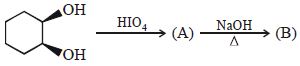
Product "$B$" is :
Which one of the following statements shows the correct percentage of carbon in steel, pig iron and wrought iron
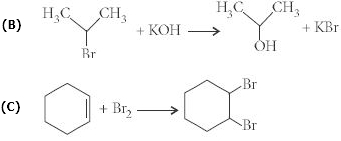
For the following reactions .  . .Which of the following statements is correct ?

$(A)\,\,CH_3CH_2CH_2Br + KOH  \rightarrow  CH_3CH CH_2 + KBr + H_2O$
Which one of the following nitrates will leave behind a metal on strong heating