MCQ
All electrons on the $4p$ sub-shell must be characterized by the quantum number $(s)$
  • A
    $n = 4,\,m = 0,\,s = \pm \frac{1}{2}$
  • $l = 1$
  • C
    $l = 0,\,s = \pm \frac{1}{2}$
  • D
    $s = \pm \frac{1}{2}$

Answer

Correct option: B.
$l = 1$
b
$n=4, m=0$

$s=\pm 1 / 2$

$l=1 \quad s=0, s=\pm 1 / 2$

$s=\pm 1 / 2$

Need a full question paper?

Generate a complete, print-ready paper with questions like this in minutes — across 16+ boards, with answer keys.

Start Generating Free

Similar questions

In the following series of chemical reactions, identify  $Z $

${{C}_{3}}{{H}_{7}}OH\underset{160-{{180}\,^{o}}C}{\mathop{\xrightarrow{Conc.{{H}_{2}}S{{O}_{4}}}}}\,X\underset{{}}{\mathop{\xrightarrow{B{{r}_{2}}}}}\,Y\underset{Alc.KOH}{\mathop{\xrightarrow{\text{Excess of}}}}\,Z$
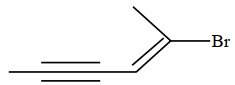
Choose the correct name for compound given below:
The product of following reaction is

$\begin{array}{*{20}{c}}
  {C{H_3}\,\,\,\,\,\,\,\,\,\,\,\,\,\,\,} \\ 
  {\,|\,\,\,\,\,\,\,\,\,\,\,\,\,\,\,\,\,\,\,\,\,\,\,} \\ 
  {C{H_3} - C - CH = C{H_2}\,\,\,\,\,} \\ 
  {\,|\,\,\,\,\,\,\,\,\,\,\,\,\,\,\,\,\,\,\,\,\,\,\,} \\ 
  {\,\,\,\,C{H_{3\,\,\,\,\,\,\,\,\,\,\,\,\,\,\,\,\,\,\,\,\,\,\,\,\,\,\,\,\,}}} 
\end{array}\xrightarrow[{(ii)\,NaB{H_4}}]{{(i)\,Hg{{(OAc)}_2};{H_2}O}}$

Which of the following is not correct
$\xrightarrow[{B{r_2}}]{{O\mathop H\limits^ \ominus  }} \, ;$ Intermediate of the given reaction is/are
The incorrect stability order of $+3$ and $+1$ states of $13^{th}$ group elements (boron family) is
If the colours of salts of transition elements are due to the presence of unpaired electrons in the transition metal ions, which of the following ions will be colourless in aqueous solution
In a mixture of a weak acid and its salt, the ratio of concentration of acid to salt is increased ten-fold. The $pH$ of the solution
Rutherford's alpha particle scattering experiment eventually led to the conclusion that
$\mathrm{X}$ of enthanamine was subjected to reaction with $\mathrm{NaNO}_2 / \mathrm{HCl}$ followed by hydrolysis to liberate $\mathrm{N}_2$ and $\mathrm{HCl}$. The $\mathrm{HCl}$ generated was completely neutralised by $0.2$ moles of $\mathrm{NaOH} . \mathrm{X}$ is . . . . $g$.