MCQ
All element in $3$$^{rd}$ period have
  • A
    An atomic number $3$
  • B
    $3$ complete sub-shells
  • Valence electrons shell
  • D
    $3$ electrons less than the octet

Answer

Correct option: C.
Valence electrons shell
c
All elements in $3^{rd}$ period have $3$ completely filled subshells (i.e $1 s , 2 s$ and $2 p$ )

Need a full question paper?

Generate a complete, print-ready paper with questions like this in minutes — across 16+ boards, with answer keys.

Start Generating Free

Similar questions

Choose the correct set of reagents for the following conversion

trans $\left( Ph - CH = CH - CH _3\right) \rightarrow$ cis $\left( Ph - CH = CH - CH _3\right)$

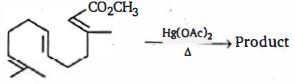
The following reaction take place in high yields.

Use your knowledge of alkene chemistry to predict  a  product even though you have never  seen this reaction before
At $NTP, 5.6\, litre$ of a gas weight $8\, gram$. The vapour density of gas is :-
$C{H_3} - C \equiv CH\xrightarrow[{H{g^{ + 2}}}]{{dil.\,{H_2}S{O_4}}}(P),\,C{H_3} - C \equiv CH\xrightarrow[{(2)\,{H_2}{O_2}}]{{(1)\,B{H_3},THF}}(Q)$, $P$ and $Q$ can be differentiated by
$\begin{array}{*{20}{c}}
  {\,C{H_3}\,\,\,\,\,\,\,\,\,\,\,\,\,} \\ 
  {|\,\,\,\,\,\,\,\,\,\,\,\,\,\,\,\,\,\,} \\ 
  {C{H_3} - C - C{H_2} - \mathop C\limits^ \oplus  {H_2}} \\ 
  {|\,\,\,\,\,\,\,\,\,\,\,\,\,\,\,\,\,\,\,} \\ 
  {C{H_3}\,\,\,\,\,\,\,\,\,\,\,\,\,\,} 
\end{array} \to \begin{array}{*{20}{c}}
  {\,\,\,\,\,\,\,\,\,\,\,C{H_3}} \\ 
  {\,\,\,\,\,\,|} \\ 
  {C{H_3} - \mathop C\limits^ \oplus   - CH - C{H_3}} \\ 
  {\,\,\,\,\,\,|} \\ 
  {\,\,\,\,\,\,\,\,\,\,\,\,\,C{H_3}} 
\end{array}$   

How many ${H^ \ominus }$ shifts are involved in above rearrangement :

Cell reaction is spontaneous, when
Which one among the following does not have the hydrogen bond
According to Le-Chatelier’s principal adding heat to a solid and liquid in equilibrium with endothermic nature will cause the
In which of the following reactions, standard reaction entropy change $(\Delta S^o)$ is positive and standard Gibb's energy change $(\Delta G^o)$ decreases sharply with increasing temperature ?
The bonds between $P$ atoms and $Cl$ atoms in $PC{l_5}$ are likely to be