Question
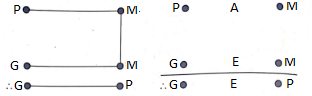
All statements are informative.
No sentence is informative.
$\therefore$ No sentence statement.
No sentence is informative.
$\therefore$ No sentence statement.
Generate a complete, print-ready paper with questions like this in minutes — across 16+ boards, with answer keys.
| (1)A $\rightarrow$ B | P |
| (2)R $\rightarrow$ S | P |
| (3)(H $\rightarrow$ J) & (J $\rightarrow$ K) | P |
| (4) (A v R) &(H v J) | P/$\therefore$ (J v K) & (B v S) |
| (5) A v R | ................ |
| (6) B v S | ................ |
| (7) J $\rightarrow$ K | ................ |
| (8)H $\rightarrow$ J | ................ |
| (9) H v J | ................ |
| (10) J v K | ................ |
| (11) (J v K) & (B v S) | ................ |
| (1)A $\rightarrow$ J | P |
| (2) B $\rightarrow$ (R v s) | P |
| (3) (A v B) & ~ D | P |
| (4) J $\rightarrow$ D | P/$\therefore$ ~ D v T |
| (5) ~ D | ................ |
| (6) A $\rightarrow$ D | ................ |
| (7) ~ J | ................ |
| (8)A v B | ................ |
| (9) J v (R v s) | ................ |
| (10)R v S | ................ |
| (11) ~ D v T | ................ |
| (1) (P & Q) $\rightarrow$ [P $\rightarrow$ (A & B)] | P |
| (2)(P & Q) & R | P/$\therefore$ A v B |
| (3)P & Q | ................ |
| (4) P $\rightarrow$ (A & B) | ................ |
| (5) P | ................ |
| (6)A & B | ................ |
| (7) A | ................ |
| (8)A v B | ................ |