MCQ
All the five digits numbers in which each successive digit exceeds its predecessor are arranged in the increasing order of their magnitude. The $97^{th}$ number in the list does not contain the digit:
  • A
    $4$
  • $5$
  • C
    $7$
  • D
    $8$

Answer

Correct option: B.
$5$
b
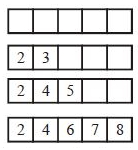
All the possible number are $^{9} \mathrm{C}_{5}$ (none containing the digit $0$ $)=126$

Total numbers starting with

$1 = {\,^8}{{\rm{C}}_4} = 70$

${ \text { (using }2,3,4,5,6,7,8,9)} $

${\text { Total starting with }}$

$\qquad 23 = {\,^6}{{\rm{C}}_3} = 20$

$(\text { using } 4,5,6,7,8,9)$

${\text { Total numbers starting with }} $

$\qquad 245 = {\,^4}{{\rm{C}}_2} = 6$

${\rm{ 9}}{{\rm{7}}^{th}}{\rm{  number }} = $
Need a full question paper?

Generate a complete, print-ready paper with questions like this in minutes — across 16+ boards, with answer keys.

Start Generating Free

Similar questions

Three vertices of a parallelogram $\text{ABCD}$ are $A(1, 2, 3), B(-1, -2, -1)$ and $C(2, 3, 2).$ Find the fourth vertex $D:$
If in a frequency distribution, the mean and median are $21$ and $22$ respectively, then its mode is approximately
The locus of a point, which moves such that the sum of squares of its distances from the points $(0,0),(1,0),(0,1)(1,1)$ is $18$ units, is a circle of diameter $\mathrm{d}$. Then $\mathrm{d}^{2}$ is equal to ...... .
If standard deviation of a data is $40$ and the coefficient of variation is $25600,$ then find the mean.
Let $Z$ and $W$ be complex numbers such that $\left| Z \right| = \left| W \right|,$ and arg $Z$ denotes the principal argument of $Z.$

Statement $1:$ If arg $Z+$ arg $W = \pi ,$ then $Z = -\overline W $.

Statement $2:$ $\left| Z \right| = \left| W \right|,$ implies arg $Z-$ arg $\overline W = \pi .$

If the normal at $(ap^2, 2ap)$ on the parabola $y^2 = 4 ax$  , meets the parabola again  at $(aq^2 , 2aq)$ , then
The value of $\mathop {\lim }\limits_{n\, \to \,\infty } \frac{{1 - {n^2}}}{{\sum n}}$ will be
Let $\alpha, \beta$ be the roots of the quadratic equation $x^2+\sqrt{6} x+3=0$. Then $\frac{\alpha^{23}+\beta^{23}+\alpha^{14}+\beta^{14}}{\alpha^{15}+\beta^{15}+\alpha^{10}+\beta^{10}}$ is equal to 
The sum of the $3^{rd}$ and the $4^{th}$ terms of a $G.P.$ is $60$ and the product of its first three terms is $1000$. If the first term of this $G.P.$ is positive, then its $7^{th}$ term is
The solution set of the inequation $|\text{x}+2|\leq5$ is: