Question
All transition elements are d-block elements, but all d-block elements are not transition elements. Explain.

Answer

There are general characteristic properties of transition elements which can only exhibit if they have partially filled d-orbitals.

These properties are:

  1. Variable oxidation states: Due to relatively low reactivity of umpaired d-orbital electrons, transition elements can exihibit two or more oxidation states.

  2. Formation of coloured compounds: Due to partially filled d-orbitals they can undergo d-d electronic transitions which results into formation of coloured compounds.

  3. Paramagnetism: Due to unpaired d-orbital electrons, the compounds of transition metals are generally found paramagnetic.

But there are few d-block elements which have fully filled d-orbital for example zinc, cadmium and mercury which cannot exhibit these properties. Thus they are not considered as transition elements.

Need a full question paper?

Generate a complete, print-ready paper with questions like this in minutes — across 16+ boards, with answer keys.
Start Generating Free

Similar questions

Write the structure of important functional group and make a table of their prefixes and suffixes according to IUPAC.
The electron energy in hydrogen atom is given by $\text{E}_{\text{n}}=\frac{ (–2.18 \times 10–18 )}{\text{n}^2}\text{J}.$ Calculate the energy required to remove an electron completely from the n = 2 orbit. What is the longest wavelength of light in cm that can be used to cause this transition?
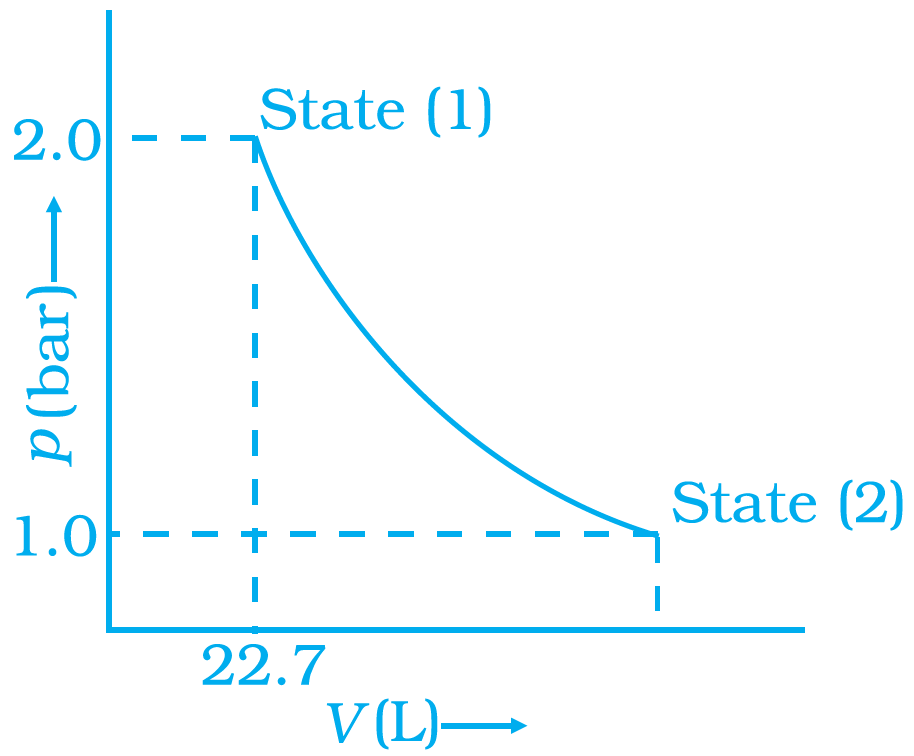
1.0 mol of a monoatomic ideal gas is expanded from state (1) to state (2) as shown in Fig. Calculate the work done for the expansion of gas from state (1) to state (2) at 298K.

  1. Commercially available concentrated hydrochloric acid contains 45% HCl by mass.
  1. What is the molarity of this solution? The density is 1.19g mL.
  2. What volume of cone. HCl is required to make 1.00L of 0.24M HCl?
  1. Write the balanced chemical equations for the following:
  1. KMnO4 + NH3 → MnO2 +KOH+ H2O + N2
  2. HNO3 + P→ NO2 + H3PO4 + H2O
Explain isomerism and nomenclature of alkynes.
Explain IUPAC system of nomenclature of elements with example.
Write the general outer electronic configuration of s-, p-, d- and f- block elements.
Calculate the pH of a 0.10 M ammonia solution. Calculate the pH after 50.0 mL of this solution is treated with 25.0 mL of 0.10 M HCl . The dissociation constant of ammonia, $K _{ b }=1.77 \times 10^{-5}$
How do atomic radius vary in a period and in a group? How do you explain the variation?