MCQ
Allyl chloride on dehydro chlorination gives
  • Propadiene
  • B
    Propylene
  • C
    Acetylchloride
  • D
    Acetone

Answer

Correct option: A.
Propadiene
a
$CH _2= CHCH _2 Cl \stackrel{\text { dehydrochlorination }}{\longrightarrow} CH _2= C = CH _2$

Need a full question paper?

Generate a complete, print-ready paper with questions like this in minutes — across 16+ boards, with answer keys.

Start Generating Free

Similar questions

$\mathrm{NO}_2$ required for a reaction is produced by decomposition of $\mathrm{N}_2 \mathrm{O}_5$ in $\mathrm{CCl}_4$ as by equation $2 \mathrm{~N}_2 \mathrm{O}_{5(\mathrm{~g})} \rightarrow 4 \mathrm{NO}_{2(\mathrm{~g})}+\mathrm{O}_{2(\mathrm{~g})}$The initial concentration of $\mathrm{N}_2 \mathrm{O}_5$ is $3 \mathrm{~mol} \mathrm{~L}^{-1}$ and it is $2.75 \mathrm{~mol} \mathrm{~L}^{-1}$ after 30 minutes.The rate of formation of $\mathrm{NO}_2$ is $\mathrm{x} \times 10^{-3} \mathrm{~mol} \mathrm{~L}^{-1}$ $\min ^{-1}$, value of $x$ is______.
The reduction of benzoyl chloride with $Pd$ and $BaSO_4/CaCO_3$ produces :
$\left[\mathrm{Co}\left(\mathrm{NH}_3\right)_6\right]^{3+}$ and $\left[\mathrm{CoF}_6\right]^{3-}$ are respectively known as:
One mole of calcium phosphide on reaction with excess of water gives
Which one of the following bases is not present in $DNA$ ?
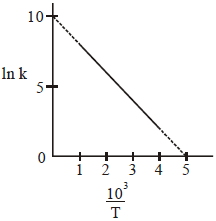
The rate constant $(k)$ of a reaction is measured at different temperatures $(T),$ and the data are plotted in the given figure. The activation energy of the reaction in $kJ\, mol ^{-1}$ is :

($R$ is gas constant)

$1\, mole$ each of following solutes are taken in $5\, moles$ water,
$(i)\, NaCl$ $(ii)\, K_2SO_4$  $(iii)\, Na_3PO_4$ $(iv)$ glucose
Assuming $100\%$ ionisation of the electrolyte, relative decrease in $V. P.$ will be in order
Which of the following will not be soluble in sodium hydrogen carbonate?
A first$-$order reaction is found to have a rate constant, $k = 5.5 \times 10^{-1}4s^{-1}.$ The time taken for completion of the reaction is:
On electrolysing a solution of dilute ${H_2}S{O_4}$ between platinum electrodes, the gas evolved at the anode is