- A

- ✓

- C

- D


$H=\frac{1}{2} \times\left(\frac{1}{R_{1}}+\frac{1}{R_{2}}\right)$
For a hemispherical, meniscus (which is the case for $0^{\circ}$ contact angle liquid,
$R_{1}=R_{2}=r$
Substituting the values in the equation,
$\mathrm{H}=\frac{1}{r}$
Thus, the graph should resemble a hyperbolic parabola with a value r at a displacement
$\mathrm{h}$
Hence, option $B$
Generate a complete, print-ready paper with questions like this in minutes — across 16+ boards, with answer keys.
Given : $1\, {ly}=9.46 \times 10^{15} \,{m},$ $\, {AU}=1.5 \times 10^{11}\, {m}$
Statement $1$ : Davisson : Germer experiment established the wave nature of electrons.
Statement $2$ : If electrons have wave nature, they can interfere and show diffraction.

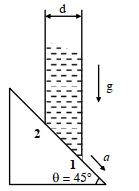
$(A)$ $\beta=0$ when $a= g / \sqrt{2}$
$(B)$ $\beta>0$ when $a= g / \sqrt{2}$
$(C)$ $\beta=\frac{\sqrt{2}-1}{\sqrt{2}}$ when $a= g / 2$
$(D)$ $\beta=\frac{1}{\sqrt{2}}$ when $a= g / 2$