MCQ
Alternating current cannot be measured by de ammeter because:
  • A
    Alternating current does not pass through ammeter.
  • Average value of current for a complete cycle is zero.
  • C
    Some part of alternating current does not pass through ammeter.
  • D
    None of the above

Answer

Correct option: B.
Average value of current for a complete cycle is zero.
(b)Average value of current for a complete cycle is zero.

Need a full question paper?

Generate a complete, print-ready paper with questions like this in minutes — across 16+ boards, with answer keys.

Start Generating Free

Similar questions

When electron changes its orbit from outer to inner energy is:
A block of mass M is hanging over a smooth and light pulley through a light string. T he other end of the string is pulled by a constant force F. The kinetic energy of the block increases by 20J in 1s.
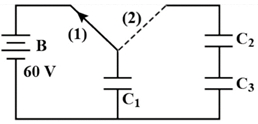
A capacitor $C_1$ is charged up to a voltage $V\, = 60\,V$ by connecting it to battery $B$ through switch $( 1)$, Now $C_1$ is disconnected from battery and connected to a circuit consisting of two uncharged capacitors $C_2\, = 3.0\,\mu F$ and $C_3\,= 6.0\,\mu F$ through a switch $(2)$ as shown in the figure. The sum of final charges on $C_2$ and $C_3$ is......$\mu C$
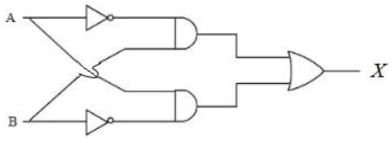
For the given logic gates combination, the correct truth table will be
Mass of atom expressed in atomic mass unit is:
When X rays pass through a strong uniform magnetic field, Then they
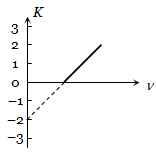
Figure represents a graph of kinetic energy (K) of photoelectrons (in eV) and frequency (v) for a metal used as cathode in photoelectric experiment. The work function of metal is
Two sources of equal $emf$ are connected to an external resistance $R$. The internal resistances of the two sources are ${R_1}$ and ${R_2}\,({R_2} > {R_1})$. If the potential difference across the source having internal resistance ${R_2}$ is zero, then
An $X-$ray has a wavelength of $0.010 Å$. Its momentum is
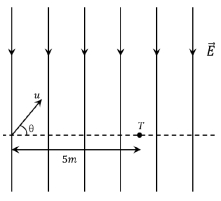
A uniform electric field, $\vec{E}=-400 \sqrt{3} \hat{y} NC ^{-1}$ is applied in a region. A charged particle of mass $m$ carrying positive charge $q$ is projected in this region with an initial speed of $2 \sqrt{10} \times 10^6 ms ^{-1}$. This particle is aimed to hit a target $T$, which is $5 m$ away from its entry point into the field as shown schematically in the figure. Take $\frac{ q }{ m }=10^{10} Ckg ^{-1}$. Then-

$(A)$ the particle will hit $T$ if projected at an angle $45^{\circ}$ from the horizontal

$(B)$ the particle will hit $T$ if projected either at an angle $30^{\circ}$ or $60^{\circ}$ from the horizontal

$(C)$ time taken by the particle to hit $T$ could be $\sqrt{\frac{5}{6}} \mu s$ as well as $\sqrt{\frac{5}{2}} \mu s$

$(D)$ time taken by the particle to hit $T$ is $\sqrt{\frac{5}{3}} \mu s$