Question
Although a prokaryotic cell has no defined nucleus, yet DNA is not scattered throughout the cell. Explain.

Answer

DNA (being negatively charged) is held with some proteins (that have positive charges) in a region termed as ‘nucleoid’. The DNA in nucleoid is organised in large loops held by proteins. Also the DNA in form of single chromosomes is attached to mesosome at a point.

Need a full question paper?

Generate a complete, print-ready paper with questions like this in minutes — across 16+ boards, with answer keys.

Start Generating Free

Similar questions

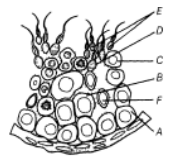
Name the labels A, B, C, D, E and F in the diagram of seminiferous tubule.
Image
Why are antibiotics always sold in combination with Lactobacillus?
“The stability of a community depends on its prosperity.” How did David Tilman demonstrate it experimentally?
With the help of an algebraic equation, how did Hardy-Weinberg explain that in a given population the frequency of occurrence of alleles of a gene is supposed to remain the same through generations?
Read the sequence of the nucleotides in the given segment of mRNA and the respective amino acid sequence in the polypeptide chain.
Image
Polypeptide: met-phe-met-proline-valine-serine
i. Provide the triplet of bases (codon) for
a. valine
b. proline
ii. Write the nucleotide sequence of the DNA strand from which this mRNA was transcribed
iii. What does the last codon of this RNA stand for?
Regulation of lac operon can be visualised as regulation of enzyme synthesis by its substrate. Explain the statement.
Following is the DNA sequence representing a part of the gene:
TAC CCC CAC GAG TTA TAT ATA CGG GGG CAT CAT ATG From it derive
  1. The RNA transcript
  2. The spliced mRNA (assuming that all codons containing a C represent the intron)
  3. The number of amino acids it can code for
Justify with the help of an example where a deliberate attempt by humans leads to the extinction of a particular species.
Which part of the plant is best suited for making virus-free plants and why ?
What are we referring to when we say 'simple organisms' or 'complex organisms'?