MCQ
Ambidentate ligand is :
  • A
    $Cl ^{-}$
  • B
    $H _2 O$
  • C
    $NH _3$
  • $NO _2^{-}$

Answer

Correct option: D.
$NO _2^{-}$
d

Need a full question paper?

Generate a complete, print-ready paper with questions like this in minutes — across 16+ boards, with answer keys.

Start Generating Free

Similar questions

Which of the following will not act as oxidising agents?
$a. \text{CrO}_3$
$b. \text{MoO}_3$
$c. \text{MoO}_3$
$d. \text{CrO}_4^{2-}$
Match the following

(a) Pure nitrogen (i) Chlorine
(b) Haber process (ii) Sulphuric acid
(c) Contact process (iii) Ammonia
(d) Deacon's process (iv) Sodium azide or Barium azide

Which of the following is the correct option ?

$(a)\quad (b)\quad  (c) \quad (d)$

Which of the following is a suboxide
The following reaction were carried out.

The final product formed in the above reaction sequence is
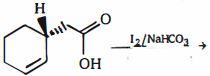
Correct order of base strength in benzene as a solvent for given amines is

$\underset{I}{\mathop{C{{H}_{3}}-C{{H}_{2}}-N{{H}_{2}}}}\,$ 

$\underset{II}{\mathop{{{(C{{H}_{3}}C{{H}_{2}})}_{2}}NH}}\,$ 

$\mathop {{{(C{H_3}C{H_2})}_3}N}\limits_{II} $

Formaldehyde is used as formalin in industries:
A $1.0\,M$ with respect to each of the metal halides $AX_3 ,\,BX_2 ,\,CX_3$ and $DX_2$ is electrolysed using platinum electrodes. If

$E_{{A^{3 + }}/A}^o = 1.50\,\,V\,,$    $E_{{B^{2 + }}/B}^o = 0.3\,\,V,$

$E_{{C^{3 + }}/C}^o =  - \,0.74\,\,V,$  $E_{{D^{2 + }}/D}^o =  - \,2.37\,\,V.$

The correct sequence in which the various metals are deposited at the cathode is

$......$ refers to amount of electricity while $......$ refers to rate at which it flows.
$\begin{array}{*{20}{c}}
  {O\,\,\,\,\,\,\,\,} \\ 
  {||\,\,\,\,\,\,\,\,\,} \\ 
  {C{H_3} - C{H_2} - C - H\xrightarrow{{\operatorname{Re} d\,P + HI}}A} 
\end{array}$ Product $A$ is
The theory that can completely/properly explain the nature of bonding in $[Ni(CO)_4]$ is