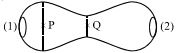
Ametallic conductor of irregular cross-section is as shown in the figure. Aconstant potential difference is applied across the ends $(1)$ and $(2)$. Then :
Diffcult


Download our appand get started for free
Experience the future of education. Simply download our apps or reach out to us for more information. Let's shape the future of learning together!No signup needed.*
Similar Questions
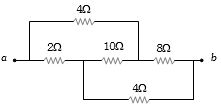
- 1Find the equivalent resistance between the points $a$ and $b$ .......... $\Omega$View Solution
- 2By which of the following single load resistance the load bridge should be replaced so that the power to the load remains unchanged ................ $\Omega$View Solution
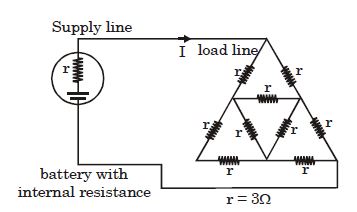
- 3The current $I$ in the given circuit will be $......A$View Solution
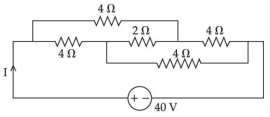
- 4View SolutionThe lead wires should have
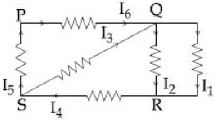
- 5In the given circuit diagram, the currents, ${I_1} = - \,0.3\,A,\,{I_4} = 0.8\,A$ and ${I_5} = 0.4\,A,$ are flowing as shown. The currents $I_2,\,I_3$ and $I_6,$ respectively areView Solution
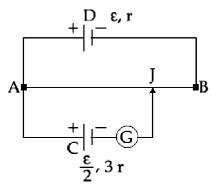
- 6A potentiometer wire $AB$ having length $L$ and resistance $12\, r$ is joined to a cell $D$ of $emf$ $\varepsilon $ and internal resistance $r$. A cell $C$ having $emf$ $\varepsilon /2$ and internal resistance $3r$ is connected. The length $AJ$ at which the galvanometer as shown in figure shows no deflection isView Solution
- 7Ratio of thermal energy released in two resistor $R$ and $3 R$ connected in parallel in an electric circuit is :View Solution
- 8The terminal potential difference of a cell when short-circuited is ($E$ = $E.M.F.$ of the cell)View Solution
- 9In the network shown in the following figure, each resistance is $1\,ohm.$ The effective resistance between $A$ and $B$ isView Solution
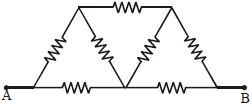
- 10In the diagram resistance between any two junctions is $R$. Equivalent resistance across terminals $A$ and $B$ isView Solution
