MCQ
Amines are basic in nature because:
  • A
    They produce $OH^-$ ions when treated with water
  • B
    They have replaceable $H$ atoms on $N$ atoms
  • They have lone pair of electron on $N$ atom
  • D
    None of these

Answer

Correct option: C.
They have lone pair of electron on $N$ atom
c

Need a full question paper?

Generate a complete, print-ready paper with questions like this in minutes — across 16+ boards, with answer keys.

Start Generating Free

Similar questions

If $50\%$  of a reaction occurs in $100$ seconds and $75\%$ of the reaction occurs in $200$ seconds, the order of this reaction is
For the first order reaction $2 N _2 O _5( g ) \rightarrow 4 NO _2( g )+ O _2( g )$

$(A)$ the concentration of the reactant decreases exponentially with time.

$(B)$ the half-life of the reaction decreases with increasing temperature.

$(C)$ the half-life of the reaction depends on the initial concentration of the reactant

$(D)$ the reaction proceeds to $99.6 \%$ completion in eight half-life duration.

For a certain first order reaction $32 \%$ of the reactant is left after $570 \,s$. The rate constant of this reaction is ...........  $\times 10^{-3} s ^{-1}$. (Round off to the Nearest Integer).

$\left[\right.$ Given $\left.: \log _{10} 2=0.301, \ln 10=2.303\right]$

Vinyl chloride reacts with $HCl$ to form
The correct structure of ethylenediaminetetraacetic acid $(EDTA)$ is
$\begin{array}{*{20}{c}}
  {C{H_3} - CH - CH - C{H_3}} \\ 
  {\,\,|\,\,\,\,\,\,\,\,\,\,\,\,\,\,\,|\,\,\,\,\,\,\,} \\ 
  {Cl\,\,\,\,\,\,\,\,\,\,\,Cl\,\,\,} 
\end{array}$ $\xrightarrow[dry\,ether]{Na}X\xrightarrow[\left( 2 \right)\,{{H}_{2}}{{O}_{2}},\overset{\Theta }{\mathop{O}}\,{{H}_{\left( aq \right)}}]{\left( 1 \right)\,B{{H}_{3}},THF}Y;\,Y$ is
Leucine amino acids is the
The major product formed in the following reaction is

$[Figure]$   $\xrightarrow[{Heat}]{{NaOC{H_3}\left( {1\,eq.} \right)}}$
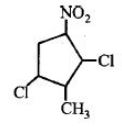
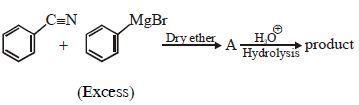
The following solutions were prepared by dissolving $10\, \mathrm{~g}$ of glucose $\left(\mathrm{C}_{6} \mathrm{H}_{12} \mathrm{O}_{6}\right)$ in $250 \,\mathrm{ml}$ of water $\left(\mathrm{P}_{1}\right)$, $10\, \mathrm{~g}$ of urea $\left(\mathrm{CH}_{4} \mathrm{~N}_{2} \mathrm{O}\right)$ in $250\, \mathrm{ml}$ of water $\left(\mathrm{P}_{2}\right)$ and $10\, \mathrm{~g}$ of sucrose $\left(\mathrm{C}_{12} \mathrm{H}_{22} \mathrm{O}_{11}\right)$ in $250\, \mathrm{ml}$ of water $\left(\mathrm{P}_{3}\right)$. The right option for the decreasing order of osmotic pressure of these solutions is :
Suppose the following reaction The structure of main product will be