MCQ
Amines are the derivatives of:
  • A
    Acids
  • B
    Ammonia
  • C
    Alkanes
  • D
    Esters

Answer

  1. Ammonia

Explanation:

Amines are derivative  of ammonia, wherein one or more hydrogen atoms have been replaced by a substituent such as an alkyl or aryl group (these may respectively be called alkylamines and arylamines; in which both types of substituent are attached to one nitrogen atom may be called alkylarylamines).

Need a full question paper?

Generate a complete, print-ready paper with questions like this in minutes — across 16+ boards, with answer keys.
Start Generating Free

Similar questions

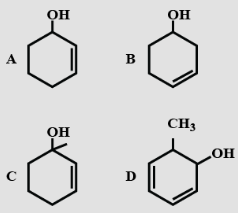
The correct decreasing order of dehydration of following alcohols with conc. H2​SO4​ is:

$S_{N^1}$ and $S_{N^2}$ products are same with (excluding stereoisomer)
The half life of forward and reverse reactions are $400\,\,sec$ and $100\,\,sec$ and these half lives are independent from the concentration of Reactant then find the equilibrium constant of the reaction
An anion solution gives a white ppt. With $AgN{O_3}$ solution. The ppt. dissolves in dil. ammonia due to the formation of
In the electrochemical cell

${H_2}\left( g \right)\,1atm\,|\,{H^ + }\left( {1M} \right)\,||\,C{u^{2 + }}\left( {1M} \right)\,|\,Cu\left( s \right)$

which of the following statements is true

For the reaction, $3A+2B \to C + D$, the differential rate law can be written as
In given some reaction correct product match will be

$(a)\,N{H_4}N{O_2}\xrightarrow{\Delta }{N_2} + {H_2}O$

$(b)\,N{H_4}N{O_3}\xrightarrow{\Delta }{N_2}O + {H_2}O$

$(c)\,N{a_2}C{O_3}\xrightarrow{\Delta }N{a_2}O + C{O_2}$

$(d)\,N{H_4}Cl\xrightarrow{\Delta }N{H_3} + HCl$

Which medium of expression of concentration is independent of temperature?
Which of the following reactions end in finite time
The rates of a certain reaction $(dc/dt)$ at different times are as follows

Time                                 Rate (mole $litre^{-1}\,sec^{ -1}$ )

$0$                                        $2.8 \times {10^{ - 2}}$

$10$                                      $2.78 \times {10^{ - 2}}$

$20 $                                     $2.81 \times {10^{ - 2}}$

$30$                                       $2.79 \times {10^{ - 2}}$

The reaction is