MCQ
Ammonium hydroxide is a weak base because
  • A
    It has low vapour pressure
  • It is only slightly ionized
  • C
    It is not a hydroxide of any metal
  • D
    It has low density

Answer

Correct option: B.
It is only slightly ionized
(b)It is a weak electrolyte since slightly ionized.

Need a full question paper?

Generate a complete, print-ready paper with questions like this in minutes — across 16+ boards, with answer keys.
Start Generating Free

Similar questions

The heat of combustion of ethanol into carbon dioxides and water is $-327\, kcal$ at constantpressure. The heat evolved (in cal) at constant volume and $27^{\circ} C$ (if all gases behave ideally) is $\left( R =2\, cal\, mol ^{-1}\, K ^{-1}\right)$
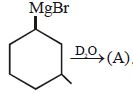
Product $(A)$ is
$B(OH)_3 + NaOH  \rightleftharpoons  NaBO_2 + Na [B(OH)_4] +H_2O$

How can this reaction is made to proceed in forward direction?

$C + O _{2}( g ) \rightarrow CO _{2} \cdots \cdots( i )$            $\Delta H =-\,393 \,kJ\,mol ^{-1}$

$H _{2}+\frac{1}{2} O _{2} \rightarrow H _{2} O , \cdots \cdots( ii )$            $\Delta H =-\,287.3 \,kJ\,mol ^{-1}$

$2 CO _{2}+3 H _{2} O \rightarrow C _{2} H _{5} OH +3 O _{2} \cdots \cdots ( iii )$;     $ \Delta H =1366.8 \,kJ\,mol ^{-1}$

Find the standard enthalpy of formation of $C _{2} H _{5} OH (1)$

For the energy levels in an atom which one of the following statements is(are) correct ?
Which of the following electrodes will act as anodes, when connected to Standard Hydrogen Electrode?
The first ionization energy for Li is $5.4 \,eV $ and electron affinity of $Cl$  is $3.61\,eV.$ The $\Delta H$ (in $kJ/mol$) for the reaction $Li(g) + Cl(g) \to L{i^ + } + C{l^ - }$ is (if resulting ions do not combine with each other) $(1\,eV = 1.6 \times {10^{ - 19}}\,J)$
For the reaction $A(g) + 2B(g)  \rightleftharpoons  2C(g) + D(s), 2\, moles$ of $A, 3\, moles$ of $B$ and $1\, mole$ of $C$ are present in $10\,L$ vessel if $K_c$ for the reaction is $3.6$, the reaction will proceed in
In carius method of estimation of halogen $0.15\,g$ of an organic compound gave $0.12\, g$ of $AgBr$. Find out the percentage......$\%$ of bromine in the compound
Electrophilic addition reactions proceed in two steps. The first step involves the addition of an electrophile. Name the type of intermediate formed in the first step of the following addition reaction.
$\text{H}_3\text{C}-\text{H}\text{C}=\text{CH}_2+\text{H}^+\rightarrow?$