MCQ
Among $H_2O, H_2S, H_2Se$ and $H_2Te$. The one with the highest boiling point is
  • A
    $H_2O$ because of hydrogen bonding
  • B
    $H_2Te$ because of higher molecular weight
  • C
    $H_2S$ because of hydrogen bonding
  • $H_2Se$ because of lower molecular weight

Answer

Correct option: D.
$H_2Se$ because of lower molecular weight
d
The oxide with the highest positive oxidation state on the element other than $O$ should be most acidic. Oxidation state of $V$ in $V_2O_5$ and $N$ in $N_2O_5$ are $+5$. But the electronegativity of $N$ is higher, making $N_2O_5$ the most acidic oxide.

Need a full question paper?

Generate a complete, print-ready paper with questions like this in minutes — across 16+ boards, with answer keys.
Start Generating Free

Similar questions

Which of the following compound gives pink colour on reaction with phthalic anhydride in conc. $H _{2} SO _{4}$ followed by treatment with $NaOH$ $?$
Compare the stabilities of the following two compounds :
$A$ : cis- $1$ -Ethyl- $3$ -methylcyclohexane
$B$ : trans- $1$ -Ethyl- $3$ -methylcyclohexane
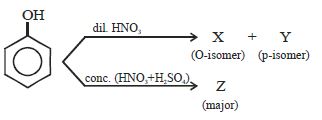
The order of acidic strength of $X, Y$ and $Z$ is
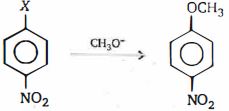
above reaction is an example of Nucleophilic aromatic substitution. Which of  the following halide $(-X)$ is most readily replaced.
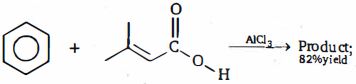
Product of the above Friedel-Craft reaction is
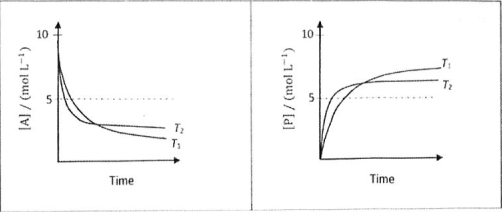
For a reaction, $A \rightleftharpoons P$, the plots of $[ A ]$ and $[ P ]$ with time at temperatures $T _1$ and $T _2$ are given below.

If $T _2> T _1$, the correct statement(s) is (are)

(Assume $\Delta H ^{\ominus}$ and $\Delta S ^{\ominus}$ are independent of temperature and ratio of $\ln K$ at $T _1$ to $\ln K$ at $T_2$ is greater than $T_2 / T_1$. Here $H, S, G$ and $K$ are enthalpy, entropy, Gibbs energy and equillibrium constant, respectively.)

$(A)$ $\Delta H ^{\ominus}<0, \Delta S ^{\ominus}<0$  $(B)$ $\Delta G ^{\ominus}<0, \Delta H ^{\ominus}>0$  $(C)$ $\Delta G ^{\ominus}<0, \Delta S ^{\ominus}<0$  $(D)$ $\Delta G ^{\ominus}<0, \Delta S ^{\ominus}>0$
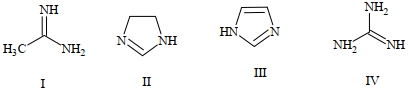
The order of basicity among the following compound is
The major product of the following reaction is
A mixture of $H_2$ and sufficient quantity of air at $25\,^oC$ aild $1\ atm$ pressure undergoes complete combustion in a closed rigid adiabatic container leaving behind $H_2O(g)$ and $N_2(g)$. If air is a mixture of $80\% N_2$ and $20\%O_2$ by volume and $C_{P(N_2 )}$ and $C_{P(H_2O)g}$ are $7.0$ and $8.0\  cal-deg^{- 1}\  mol^{-1}$ respectively. What will be max imum temperature attained ?

( Given that : ${\left( {\Delta {H^o}_f} \right)_{{H_2}O(g)}} =  - 56.0\,\,kcal/mol$ and it is independnet of temperature).......$ K$ 

The oxidation potential of a hydrogen electrode at $pH = 10 $ and $p{H_1} = 1$ ........... $\mathrm{V}$