MCQ
Among $Ni(CO)_4,\, Ni(CN)_4^{2-}$ and $[Ni(Cl)_4]^{2-}$
  • A
    $Ni(CO)_4$ and $NiCl_4^{2-}$ are diamagnetic and $Ni(CN)_4^{2-}$ is paramagnetic
  • B
    $NiCl_4^{2-}$ and $Ni(CN)_4^{2-}$ are diamagnetic and $Ni(CO)_4$ is paramagnetic
  • $Ni(CO)_4$ and $Ni(CN)_4^{2-}$ are diamagnetic and $NiCl_4^{2-}$ is paramagnetic
  • D
    $Ni(CO_4)$ is diamagnetic and $NiCl_4^{2-}$ and $Ni(CN)_4^{2-}$ are paramagnetic
Answer

Correct option: C.
$Ni(CO)_4$ and $Ni(CN)_4^{2-}$ are diamagnetic and $NiCl_4^{2-}$ is paramagnetic
c
$Ni(CO)_4$ and $[Ni(CN)_4]^{2-}$ are diamagnetic $[NiCl_4]^{2-}$ are paramagnetic

Need a full question paper?

Generate a complete, print-ready paper with questions like this in minutes — across 16+ boards, with answer keys.

Start Generating Free

Similar questions

Which of the following complex will show geometrical as well as optical isomerism ($en = $ ethylene diamine)
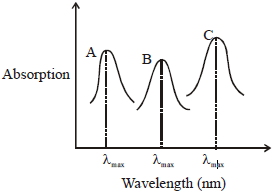
Simplified absorption spectra of three complexes $((i),$$( ii)$ and $( iii ))$ of $M ^{ n +}$ ion are provided below; their $\lambda_{\max }$ values are marked as $A, B$ and $C$ respectively. The correct match between the complexes and their $\lambda_{\max }$ values is

$(i)$ $\left[ M ( NCS )_{6}\right]^{(-6+ n )}$

$(ii)$ $\left[ MF _{6}\right]^{(-6+ n )}$

$(iii)$ $\left[ M \left( NH _{3}\right)_{6}\right]^{ n ^{+}}$

The sum of bridging carbonyls in $W ( CO )_6$ and $Mn _2$ $( CO )_{10}$ is $............$.
If the rate expression for a chemical reaction is given by Rate $ = k{[A]^m}{[B]^n}$
Compound $\mathrm{A}, \mathrm{C}_{8} \mathrm{H}_{10} \mathrm{O},$ is found to react with $\mathrm{NaOI}$ (produced by reacting $Y$ with $NaOH$) and yields a yellow precipitate with characteristic smell.

$\mathrm{A}$ and $\mathrm{Y}$ are respectively

Which Nernst equation is correct for the following cell?
$Al _{(3)}\left| Al _{(a q}^{3+} \| Zn _{(a q)}^{2+}\right| Zn _{(5)}$
Alkyl halides can be converted into Grignard reagents by
The compounds [Co(SO4)(NH3)5]Br and [Co(SO4)(NH3)5]Cl represent:
$1.00\,gm$ of a non-electrolyte solute dissolved in $50\,gm$ of benzene lowered the freezing point of benzene by $0.40\,K$. ${K_f}$ for benzene is $5.12\,\,kg\,mol^{-1}. $ Molecular mass of the solute will be ............ $g\,mo{l^{ - 1}}$
How many total oximes are possible for ketons having molecular formula $C_3H_6O$,$C_4H_8O$ and $C_5H_{10}O$